
The Structural Transformation of Transnational Higher Education in the Indian Context
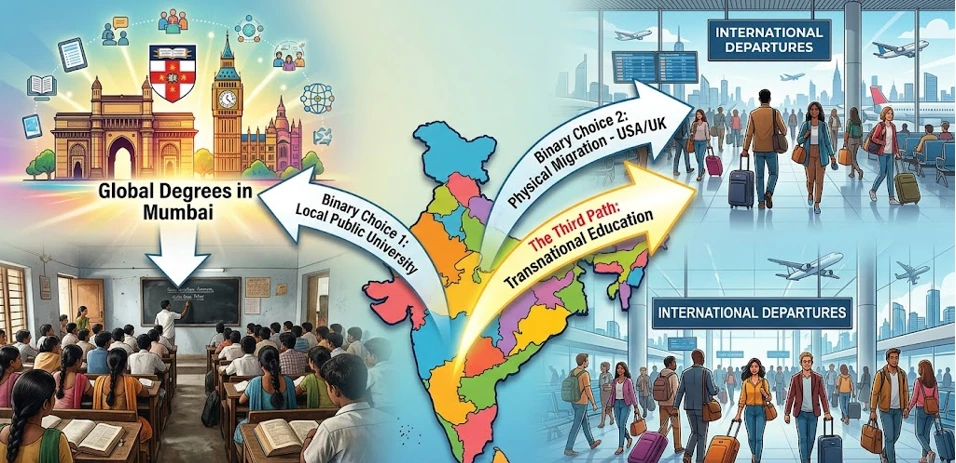
The landscape of higher education in India is undergoing a massive structural shift, driven by a growing demand for globally competitive skills and a re-evaluation of traditional academic pathways. Historically, Indian families viewed the acquisition of a foreign degree as a binary choice: either a student remained within the local public university framework or they migrated physically to Western education hubs such as the United Kingdom, the United States, or Australia. This migration, while prestigious, has long been associated with massive capital flight, severe currency risk, social displacement, and a phenomenon of “brain drain” that stripped the domestic economy of top-tier youth talent.
In 2026, the rise of transnational higher education has offered a compelling third path: the acquisition of globally recognized international undergraduate education in Mumbai, allowing students to earn elite foreign degrees locally. This shift is not merely a matter of convenience; it represents a systematic realignment of academic quality, financial prudence, and strategic career mapping. Modern tertiary education requires analytical rigor, interdisciplinary flexibility, and practical industry integration. These qualities are often difficult to find in traditional, highly rigid public university systems in India, which remain constrained by outdated curricula and rote-learning evaluation methods.
Institutional Foundations of Russell Square International College in Mumbai
To understand how an institution can offer a top-notch educational environment that stands out in a competitive market, one must examine its structural and regulatory foundations. Established in 2004 in Juhu, a premium commercial and residential hub in Mumbai, Russell Square International College in Mumbai was founded with a clear vision: to bring world-class international courses in India to ambitious, globally-minded students. The institution operates as a sister school to Ecole Mondiale World School, one of India’s leading international schools, which ensures a deep understanding of international pedagogy.
The academic programs are divided into specialized pathways led by world-renowned member institutions:
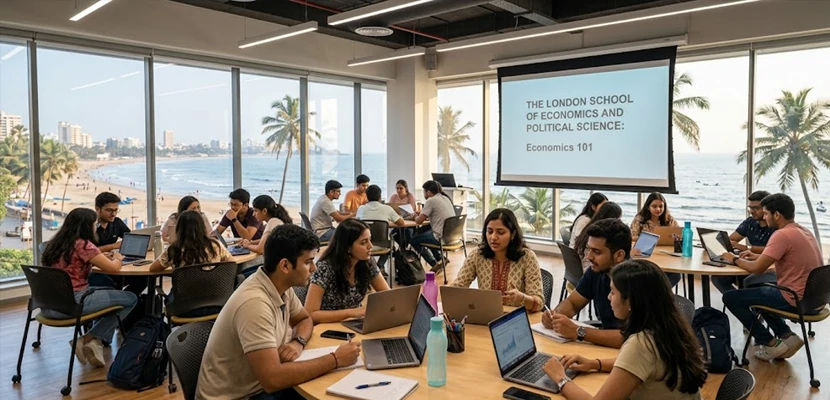
- The London School of Economics and Political Science (LSE) provides academic direction for the Economics, Finance, Accounting, and Business & Management degrees. This ensures that the analytical and quantitative rigor of LSE’s social sciences department is maintained in the Juhu classrooms.
- Royal Holloway, University of London, provides academic direction for the BSc in Business Administration and its various specializations.
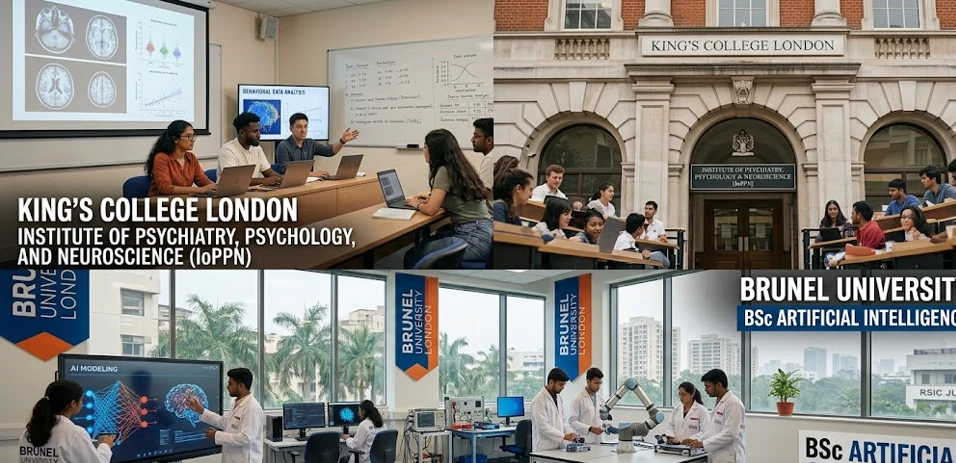
- King’s College London directs the honors pathway in Psychology, drawing on the clinical and research expertise of its highly regarded Institute of Psychiatry, Psychology, and Neuroscience (IoPPN).
- Brunel University provides academic direction for the BSc in Artificial Intelligence, preparing students to work with machine learning, neural networks, and advanced data-driven systems.
This academic structure ensures that students receive their degrees directly from the University of London upon completion. These degrees carry the same global recognition and prestige as those earned by students studying on-campus in the UK, opening doors to top-tier postgraduate programs and global corporate recruiting pipelines from New York to Singapore.
Holistic Development, Campus Life, and the Juhu Ecosystem
Academics are only one part of a complete higher education experience. A truly top-notch educational environment must also support student wellness, personal growth, and professional networking. The location of Russell Square International College in Mumbai—on Gulmohar Cross Road No 9 in the JVPD Scheme, Juhu—is a key asset in this regard. Juhu is a premium residential and commercial area that offers a safe, inspiring environment close to both quiet coastal areas and vibrant commercial districts.
Smart classrooms are fully air-conditioned and equipped with modern multimedia projectors, high-definition displays, and collaborative seating. This physical setup supports a modern teaching pedagogy that emphasizes student-led presentations, case-study discussions, and team workshops over passive lectures.
For research, students have access to a well-stocked physical library on campus, along with a comprehensive digital Virtual Learning Environment (VLE) that provides access to the extensive online databases and journals of the University of London.
This active campus life helps students build a diverse community. By organizing and leading clubs like the Debate Society, the Finance Club, and the Psychology Forum, students develop practical leadership, cross-cultural communication, and organizational skills.
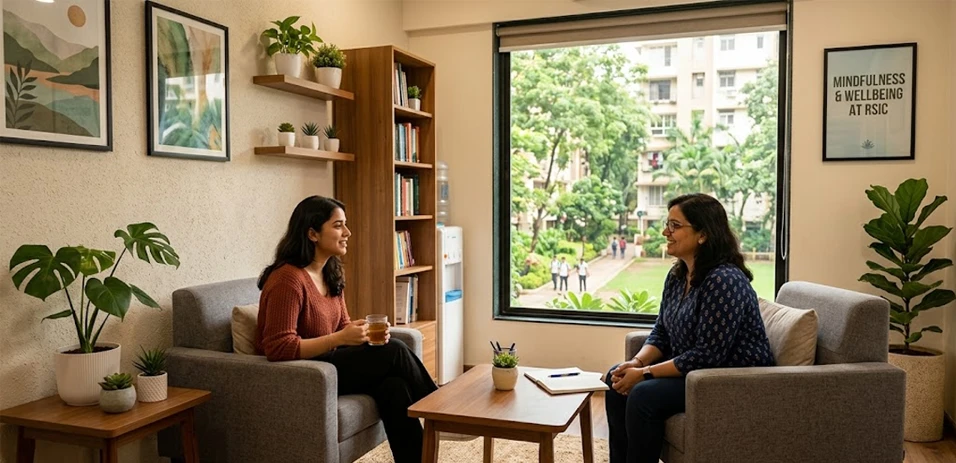
Additionally, the college employs trained counselors to provide mental health and wellness support, helping students manage the academic transition to university life in a supportive, inclusive environment.
Conclusion
The growth of transnational higher education has changed the decision-making process for Indian families planning for undergraduate study. The choice is no longer limited to basic local programs or expensive, high-risk physical relocation abroad. Transnational programs offer a balanced alternative, allowing students to earn prestigious global degrees locally.
Ultimately, the choice of an undergraduate program establishes the foundation for a student’s professional and personal development. For globally-minded students seeking an academically rigorous, financially prudent, and career-aligned education, pursuing international undergraduate education in Mumbai at Russell Square International College provides a strategic pathway to long-term success in an interconnected world.