
The Evolution of International Undergraduate Education in Mumbai
International undergraduate education in Mumbai is undergoing a structural paradigm shift driven by the National Education Policy (NEP 2020), University Grants Commission (UGC) liberalization, and the launch of direct foreign branch campuses. This transformation enables Indian students to earn fully accredited global degrees locally, removing the financial and logistical barriers of migrating abroad.
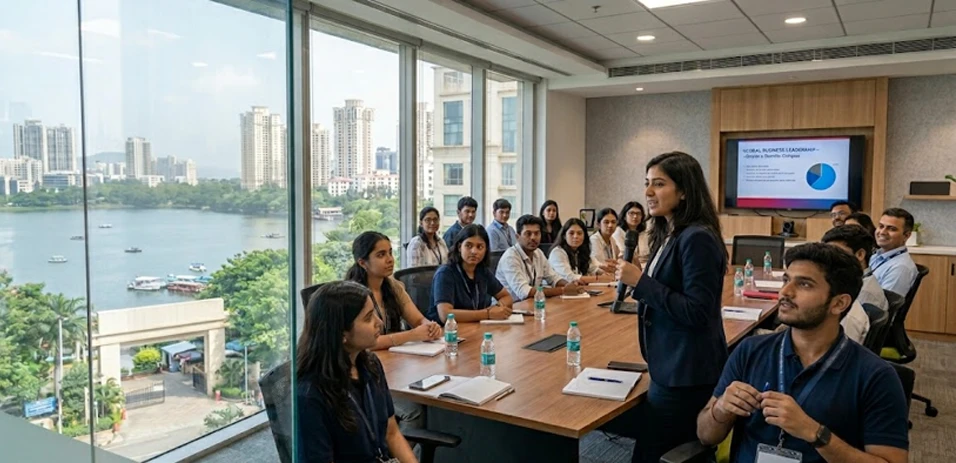
The growth of international undergraduate education in Mumbai is directly linked to the global demand for cross-cultural professional competence. Modern multinational corporations require a workforce that can operate across diverse legal, political, and economic landscapes. To meet this need, international courses in India are designed with a focus on real-world applications, empirical learning, and direct industry integration. Consequently, students are no longer confined to localized academic options. Instead, they can study rigorous curricula developed by elite global universities while remaining connected to the local market. This approach ensures that graduates are highly competitive in both regional and international talent pools.
For families evaluating collegiate options in 2026, the key priority is identifying a top-notch educational environment that supports intellectual curiosity, provides modern infrastructure, and facilitates global career mobility. Choosing between a Recognized Teaching Centre, a dual-degree program, or a direct branch campus requires a detailed understanding of how these distinct academic models operate. This comprehensive report deconstructs the top five international degree colleges in Mumbai in 2026, analyzing their curricula, financial structures, campus facilities, and admissions criteria.
Deconstructing the Concept of a Top-Notch Educational Environment
A top-notch educational environment for international studies is defined by a low student-to-teacher ratio, modern technology-enabled infrastructure, research-led pedagogy, and comprehensive career support. It integrates specialized laboratories, digital library systems, and collaborative spaces to bridge the gap between academic theory and practical application.
In the context of international undergraduate education in Mumbai, creating a top-notch educational environment goes beyond standard classroom instruction. It requires building a campus ecosystem where theory and practice reinforce each other. This is achieved through interactive lectures, case-study analyses, problem-based learning (PBL), and structured industry projects. By limiting intake and maintaining small batch sizes, institutions can offer personalized mentoring, helping students build the confidence and critical thinking skills required to lead in a globalized economy.
Furthermore, the geographic location of a campus plays a critical role in shaping the educational environment. Campuses situated within prominent corporate and technology corridors, such as Powai, Vikhroli, or the Juhu Vile Parle Development (JVPD) scheme, provide valuable opportunities for corporate interaction. Students benefit from proximity to major financial hubs, technology startups, and multinational corporations. This allows colleges to integrate masterclasses by industry leaders, corporate site visits, and professional internships directly into the academic calendar.
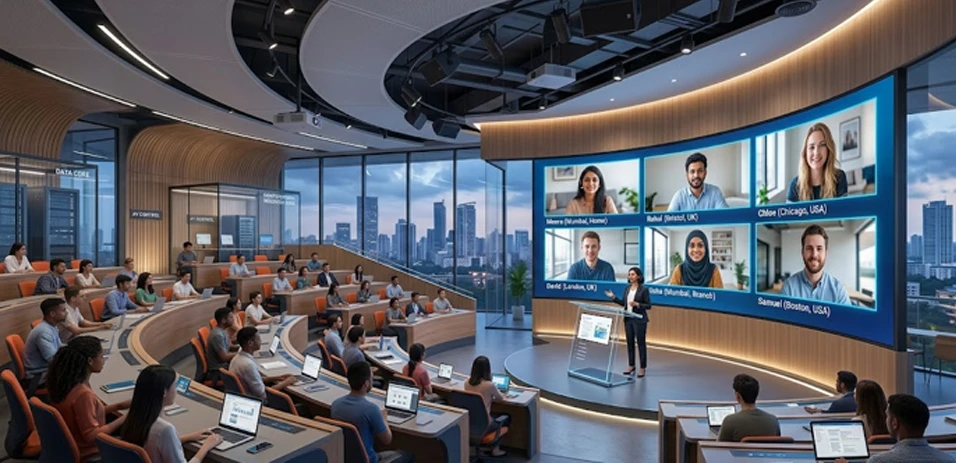
The infrastructure of a smart campus in 2026 is designed to support hybrid learning models, computational research, and creative collaboration. It features lecture halls equipped with modern audio-visual technology, subject-specific labs, and dedicated innovation hubs. Additionally, students have access to extensive digital libraries, peer-reviewed international journals, and global learning networks. This comprehensive support system ensures that students pursuing international courses in India receive the same standard of education as their peers studying at parent campuses in the UK or US.
The Strategic Financial Model of Earning a Global Degree Locally
Earning an international degree locally in Mumbai provides a significant financial advantage, allowing students to access identical academic credentials and global mobility pathways at approximately one-third to one-fourth the cost of studying abroad. This model eliminates expensive international student tuition rates, visa application fees, and high overseas living costs.
When analyzing the financial feasibility of international undergraduate education in Mumbai, families must evaluate the total cost of attendance over the duration of the program.
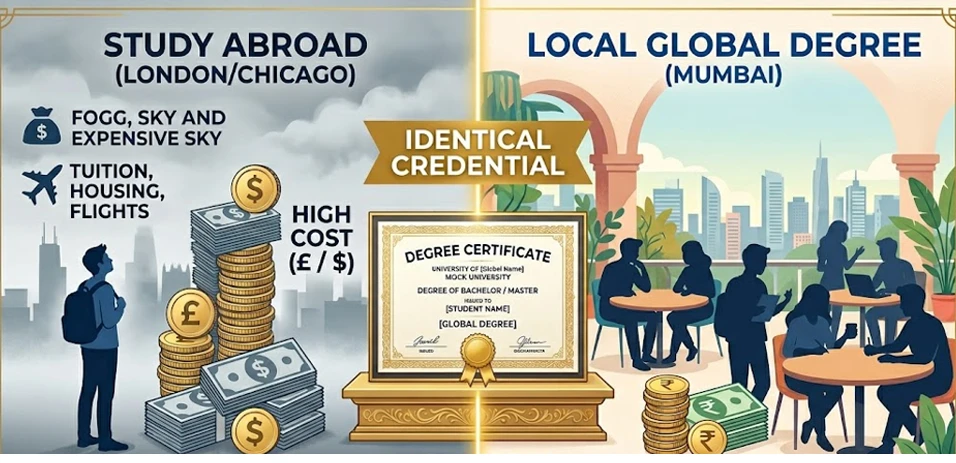
The establishment of direct branch campuses and recognized teaching centres in India has changed the economics of global education. By studying in Mumbai, domestic students pay localized tuition fees, which are significantly lower than the international fees charged on home campuses in London, Bristol, or Chicago. Additionally, remaining in India avoids the high cost of overseas student accommodation, international travel, and compulsory health insurance premiums.
Campus Facilities, Infrastructure, and Placement Support
Russell Square International College in Mumbai provides a comprehensive, modern campus infrastructure and professional placement services designed to facilitate holistic student development and maximize global career mobility. Located in Juhu, the campus is designed to support both rigorous intellectual inquiry and physical recreation.
The campus is equipped with highly specialized facilities that cater to the diverse needs of students enrolled in international courses in India :
- Air-Conditioned Classrooms: Equipped with modern teaching aids, interactive whiteboards, high-definition projectors, and ergonomic seating arrangements.
- State-of-the-Art Library: Features a wide collection of international textbooks, peer-reviewed academic journals, corporate periodicals, and quiet study zones to cultivate lifelong reading habits.
- Computer Laboratory: Fully connected, high-speed computer terminals equipped with specialized data analytics, statistical modeling, and programming software.
- Seminar Hall & Auditorium: A modern, acoustic-treated presentation facility capable of hosting over 200 corporate guests, academic conferences, and student-led panels.
- Physical Recreation Facilities: Promotes a balanced lifestyle by providing access to a professional football turf, basketball court, standard swimming pool, fully equipped gymnasium, and indoor gaming spaces for table tennis, carrom, and snooker.
The professional transition of students from academia to the global marketplace is managed by a dedicated Placement Cell. The cell works closely with students to refine soft skills, conduct mock interviews, facilitate corporate networking, and secure placements at leading global firms.
University of Bristol Mumbai Enterprise Campus
The University of Bristol Mumbai Enterprise Campus, located in Cignus Powai, represents a milestone as one of the direct foreign university campuses approved by the University Grants Commission (UGC) of India. Opening in 2026, the campus delivers identical University of Bristol degrees at approximately one-third the cost of studying in the United Kingdom, without requiring a UK student visa.
University of York Mumbai Campus
The University of York Mumbai Campus, launching in the Powai Business District in 2026, brings the academic rigor of a Russell Group university directly to India’s financial capital. As an institution committed to the “public good,” the campus delivers identical University of York degrees, utilizing research-led teaching and Problem-Based Learning (PBL) methodologies.

University of Aberdeen Mumbai Campus
The University of Aberdeen Mumbai Campus, launching in Powai in September 2026, represents a significant development in UK-India academic partnerships. Established as the first Scottish university branch campus in India, this 530-year-old institution delivers identical UK qualifications in a student-centric environment.
This direct branch campus provides access to Scottish academic heritage and future-focused curricula. It offers a top-notch educational environment for students pursuing international courses in India.
Illinois Institute of Technology Mumbai Campus
The Illinois Institute of Technology Mumbai Campus is the first American university approved by India’s University Grants Commission to offer direct U.S. degrees in India. Taught by international faculty, the programs mirror the Chicago curriculum, delivering globally recognized STEM and business degrees without requiring students to relocate abroad.
This campus features advanced computer laboratories, research centers, and collaborative spaces. It provides a top-notch educational environment for students pursuing international courses in India.
Comprehensive FAQ
How do international courses in India compare to studying abroad in terms of final degree certificates?
Students enrolled in international courses in India at direct branch campuses or recognized teaching centres receive identical degree certificates as peers studying on home campuses abroad. The certificates do not make a distinction regarding the location of study, ensuring full global validity.
What are the main benefits of a top-notch educational environment for international undergraduate education in Mumbai?
A top-notch educational environment for international undergraduate education in Mumbai provides direct access to modern learning resources, industry connections, and globally experienced faculty. It bridges the gap between theoretical models and real-world application.
This model combines rigorous academic theory with experiential learning.
Is Russell Square International College in Mumbai accredited by Indian universities?
Russell Square International College in Mumbai is a Recognized Teaching Centre of the University of London and maintains equivalencies with prominent Indian universities. This allows graduates to transition to postgraduate studies locally or globally.
Conclusion
The establishment of direct branch campuses, dual-degree configurations, and recognized teaching centres in Mumbai has transformed the landscape of international undergraduate education in Mumbai. For families evaluating these options in 2026, the decision should be guided by a clear understanding of each program’s structure, financial requirements, and long-term career pathways.
This structured approach allows families to navigate the diverse range of international courses in India, helping them select an institution that matches the student’s academic potential and career aspirations.