
The Paradigm Shift in Indian Higher Education: The Rise of Transnational Systems
The landscape of higher education in India is undergoing a profound structural metamorphosis, driven by the dual forces of globalization and the rapid digitisation of the global knowledge economy. Historically, ambitious scholars seeking globally recognized credentials had no alternative but to undergo physical migration, encountering substantial financial outlays, cultural dislocation, and complex regulatory frameworks. However, the maturation of transnational education (TNE) frameworks has revolutionized this paradigm, facilitating the local delivery of world-class academic programs. Today, the opportunity to pursue international courses in India allows high-school graduates to read for prestigious British degrees locally, balancing the pedagogical rigor of world-class universities with the contextual and geographic advantages of remaining in India’s financial capital. Consequently, the market for international undergraduate education in Mumbai has witnessed an unprecedented surge in demand, as families increasingly prioritize global employability, cost-effective academic models, and seamless pathways to elite post-graduate destinations.

Within this expanding educational ecosystem, the University of London (UoL) external system represents a premier standard of academic excellence. Established by Royal Charter in 1836, the University of London is a historic federation of eighteen self-governing member institutions, which have built international reputations for their teaching and research. Rather than functioning as a singular campus, the UoL international system relies on a federated architecture where member colleges—colloquially referred to as “Lead Colleges”—provide the academic direction for specific degree programs. Under this framework, the syllabus, core subject guides, pedagogical standards, and terminal examinations are designed and graded directly by these constituent colleges, such as the London School of Economics and Political Science (LSE), Royal Holloway, and King’s College London. This guarantees that a student reading for a UoL degree in Mumbai undergoes the exact same academic evaluation as their counterparts in London.
To deliver these rigorous programs in person, the University of London partners with select local institutions designated as Recognized Teaching Centres. Within the metropolitan limits of Mumbai, two institutions situated in the affluent coastal suburb of Juhu have emerged as the leading providers of these prestigious degrees: Russell Square International College (RSIC) and Podar World College (PWC). While both institutions operate under the broad regulatory framework of the University of London, they represent fundamentally distinct educational philosophies, structural affiliations, operational models, and student support systems. This comprehensive report delivers an exhaustive, multi-dimensional comparative analysis of these two leading centers, evaluating their institutional heritage, academic portfolios, curricular architectures, physical infrastructure, financial models, global mobility options, and career placement systems to assist academic stakeholders in identifying the optimal top-notch educational environment tailored to their individual scholarly and professional trajectories.

Comparison of Institutional Foundations and Strategic Positioning
To clearly understand the structural differences between these two premier institutions, it is necessary to compare their foundational attributes side by side. The following table delineates the core organizational, leadership, and affiliation metrics of RSIC and PWC.
| Metric / Dimension | Russell Square International College (RSIC) | Podar World College (PWC) |
| Year of Establishment | 2004 | 2007 |
| Institutional Backing | International Knowledge Park / École Mondiale World School | Podar Education Trust (99-year legacy, 149+ schools) |
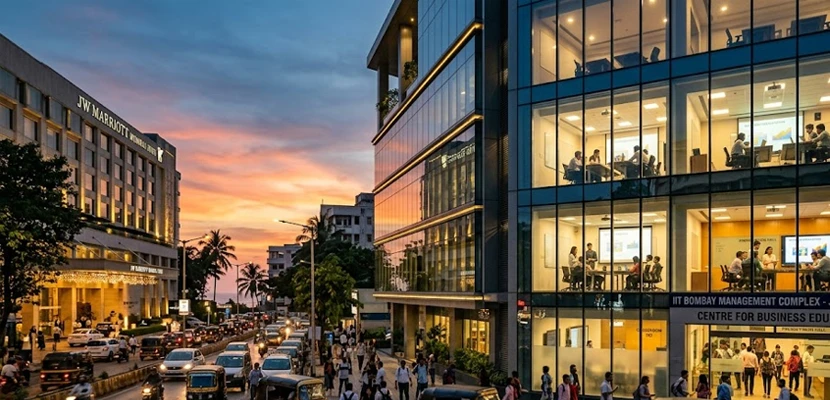
| Geographic Location | Gulmohar Cross Road No. 9, JVPD Scheme, Juhu, Mumbai | Juhu Tara Road, Opposite JW Marriott, Juhu, Mumbai |
| Lead Academic Directors (UoL) | LSE, Royal Holloway, King’s College London | LSE, Royal Holloway |
| Alternative Academic Partners | Brunel University (BSc AI) | University of Wolverhampton, Pearson |
| Regulatory Equivalence Integration | Prestigious UoL global degree alignment | Dual-degree integration via YCMOU (UGC recognized) |
| Institutional Head | Dr. Swati Singh (Principal & Professor of Marketing) | Dr. Vandana Lulla (Dean) |
| Leadership Specialization | Sustainable Marketing, Brand Management, IIM-A Alumni | Learning Disabilities, Educational Tech, CIS/IB Evaluator |
| Physical Campus Character | Expansive, integrated with premium IB school assets | Vertically integrated, highly corporate, central urban Juhu |
| Primary Sports Infrastructure | On-campus football turf, basketball court, swimming pool, gym | Annual organized sports tournaments at external complexes |
Curricular Frameworks of Flagship Degrees
To illustrate the structural differences between a highly quantitative LSE-directed program and a specialized scientific program, the following table compares the module configurations of the LSE-directed BSc Economics and Finance (offered at both centers) and the King’s College London-directed BSc Psychology (offered at RSIC).
| Academic Year | BSc Economics & Finance (LSE Directed) | BSc Psychology (KCL Directed – RSIC Only) |
| Year 1 (Level 4) | • Introduction to Economics
• Mathematics I & Statistics I
• Principles of Banking & Finance
• Principles of Accounting |
• Eight 15-credit compulsory modules:
• Computational Foundations of Psychology
• Social & Developmental Psychology
• Research Methods & Statistics I |
| Year 2 (Level 5) | • Macroeconomics
• Microeconomics
• Elements of Econometrics
• Asset Pricing & Financial Markets |
• Eight 15-credit compulsory modules:
• Cognitive Processes
• Biological Psychology
• Research Methods & Statistics II
• Applied Psychology |
| Year 3 (Level 6) | • Quantitative Finance
• Principles of Corporate Finance
• Monetary or Industrial Economics
• Investment Management or Strategy |
• Six 15-credit specialized modules:
• Clinical & Health Psychology
• Organizational Behavior
• One 30-credit Empirical Research Project (8,000-word thesis) |
| Assessment Model | • 100% High-stakes terminal written examinations graded directly by LSE in London. | • Modular Assessment:
• 30% Continuous (coursework & lab reports)
• 70% Terminal Examinations (March & Sept cycles). |
Quantitative Demands and Academic Rigor: Syllabus and Assessment Methodologies
The high-stakes academic nature of these programs is designed to build analytical capacities, but it also demands a high level of mathematical preparation. Consequently, both institutions enforce strict entry eligibility criteria, placing a strong emphasis on a student’s mathematical and statistical aptitude.

RSIC and PWC Entry Criteria and Mathematics Prerequisites
Because both centers deliver the exact same University of London syllabus, their minimum academic entry requirements are aligned with UoL’s international admission standards. However, their localized admission processes and academic tracking exhibit slight differences in how they evaluate and support students who may not have pursued mathematics at the higher secondary level.
To provide clear, structured guidance for prospective applicants, the following table outlines the minimum eligibility criteria and mathematical prerequisites for Indian board students at both institutions.
| Academic Board | RSIC Admission Eligibility | PWC Admission Eligibility |
| All India Boards (CBSE / ISC) | • Completion of Class XII with minimum overall average of 70% in 4 acceptable academic subjects.
• Mathematics & English: Minimum 50% each. |
• Completion of Class XII with minimum overall average of 70% in 4 acceptable academic subjects.
• Mathematics: Minimum 70% or above in Class XII. |
| Prerequisite Alternative (CBSE / ISC) | • If Mathematics is not cleared in Class XII, a minimum of 50% in Class X Mathematics is accepted. | • If Mathematics is not passed at 70%+ in Class XII, Class X Mathematics must be passed at 50% or above. |
| Maharashtra State Board (HSC) | • Completion of Class XII with minimum overall average of 70% in 4 acceptable academic subjects.
• Mathematics & English: Minimum 50% each. |
• Completion of Class XII with minimum overall average of 70% in 4 acceptable academic subjects.
• Mathematics: Minimum 70% or above in Class XII. |
| Prerequisite Alternative (HSC) | • If Mathematics is not cleared in Class XII, a minimum of 50% in Class X Mathematics is accepted. | • If Mathematics is not passed at 70%+ in Class XII, Class X Mathematics must be passed at 80% or above. |
| International Baccalaureate (IB) | • Successful completion of the IB Diploma with strong academic performance. | • Successful pass of IB Diploma with 3 points in Higher Level (HL) Maths OR 4 points in Standard Level (SL) Maths. |
| Age Requirement | • Minimum age ranges between 17 and 18 years at the time of admission. | • Standard UoL age guidelines apply to ensure academic and social maturity. |
This eligibility matrix shows that both institutions accommodate students who did not pursue advanced mathematics in high school, providing accessible pathways into elite global economics and finance programs. However, the quantitative nature of the LSE curriculum means that students admitted through the Class X mathematics alternatives must undergo intensive local preparation to bridge the quantitative gap once the program begins.
Conclusion
Both Russell Square International College and Podar World College have established themselves as premier centers of excellence for international undergraduate education in Mumbai. Situated in the vibrant coastal suburb of Juhu, both institutions offer ambitious Indian scholars the rare privilege of earning globally recognized, academically rigorous British degrees without having to face the immediate financial and personal challenges of moving abroad. However, their differing institutional philosophies require families to make a strategic choice.
Russell Square International College in Mumbai represents a premium, research-driven international academy. Backed by its close alignment with École Mondiale World School and guided by the scholarly leadership of Dr. Swati Singh, RSIC offers an expansive, sports-equipped campus, elite scientific tracks under King’s College London and Brunel, and a highly structured, research-centric academic culture. It is the ideal choice for students who seek deep intellectual training, plan to pursue advanced academic research, or thrive in a highly focused, campus-centric learning environment.
Podar World College (PWC) excels as a highly pragmatic, employer-focused business and economics hub. Guided by the global educational expertise of Dean Dr. Vandana Lulla and backed by the historic 99-year legacy of the Podar Education Trust, PWC offers a highly cost-effective, multi-tiered pathway system, a unique dual-degree strategy that secures UGC recognition via YCMOU, and a vibrant student life driven by its legendary Rotaract club and summer scholarship programs. It represents the optimal choice for students who prioritize immediate corporate placement, practical entrepreneurial skills, and a highly collaborative, socially engaged university experience.
Ultimately, the decision must be customized to the student’s academic aptitude, learning style, and long-term career goals. By selecting the institution that aligns with their personal learning trajectory, students can leverage the power of international courses in India to build a global career, transforming themselves into highly competent, socially responsible global citizens who are prepared to lead in the dynamic global economy.