
The London Survival Guide: Essential tips for RSIC students making the final jump
Introduction: The Architecture of Transnational Education
The modern landscape of higher education is increasingly defined by transnational academic pathways that bridge continents, cultures, and economic systems. At the absolute forefront of this educational evolution is Russell Square International College in Mumbai, an institution established in August 2004 by the visionary promoters of École Mondiale World School.
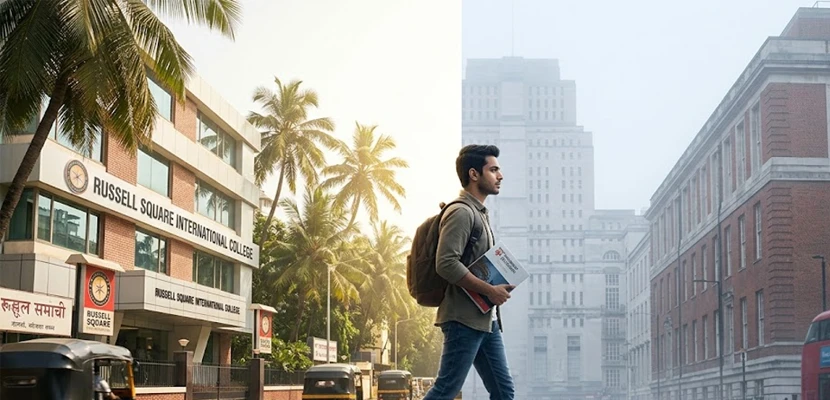
Located on Gulmohar Cross Road No 9 within the prestigious J.V.P.D. Scheme in Juhu, Mumbai, the college has spent over two decades serving as a premier gateway for scholars aspiring to acquire world-class credentials without immediately leaving the supportive structures of their home country. As an officially recognized teaching center of the University of London, the institution successfully delivers a highly rigorous curriculum designed, directed, and assessed by some of the United Kingdom’s most elite academic member institutions.
For ambitious students seeking a premier international undergraduate education in Mumbai, the college offers a unique and highly structured pathway to global markets. Rather than confronting the immediate, often destabilizing cultural and academic shock of relocating to a foreign country straight after secondary school, undergraduates are integrated into a “2+1” twinning model. Under this framework, candidates complete the first two years of their degree locally in Juhu before transferring directly to a UK campus for their final year. This pedagogical model enables students to engage with highly challenging international courses in India while progressively developing the cognitive independence, research capabilities, and critical thinking skills required to thrive in the United Kingdom.

The success of this transition relies heavily on the quality of the preparatory environment. The college prides itself on maintaining a top-notch educational environment that mirrors the precise academic standards, examinations, and grading criteria enforced on-site in London. All examinations, regardless of where they are physically completed, are sent directly to London to be marked and assessed by the University of London’s member institutions. This structural alignment ensures that the degree awarded directly by the University of London carries identical global credibility and rigor, opening doors to prestigious postgraduate programs and corporate careers worldwide.
The Cognitive Transition from Rote Learning to Causal Proofs
One of the most profound challenges confronting undergraduates who make the final jump from the Indian secondary education system to a UK university is the direct encounter with a radically different academic philosophy. The vast majority of students entering Russell Square International College in Mumbai have completed their secondary schooling under national boards such as the CBSE, ISC, or state HSC frameworks. While these boards are highly effective at developing structured work ethics and a comprehensive baseline of factual knowledge, their assessment methodologies are fundamentally different from the analytical expectations of a world-class British university.
National school boards in India traditionally reward rote memorization, the precise recall of pre-defined textbook paragraphs, and the structured reproduction of standardized answers during high-stakes, end-of-year examinations. Conversely, the academic curriculum designed by LSE and Royal Holloway treats standard textbooks merely as introductory summaries.

The primary objective of the international undergraduate education in Mumbai delivered at the college is to systematically dismantle this reliance on rote learning, encouraging students to cultivate systematic skepticism and intellectual independence.
At Russell Square International College in Mumbai, students are trained to navigate these Western expectations from day one, utilizing standard citation styles (such as Harvard, APA, or Chicago) and analyzing their papers through automated plagiarism-detection tools before submission.
By cultivating this rigorous academic mindset within a highly supportive, top-notch educational environment, the college ensures that the final leap to London is not an overwhelming academic shock, but a natural progression of the student’s cognitive training. Undergraduates arrive in the UK already fluent in the language of quantitative modeling, logical synthesis, and empirical critique, enabling them to secure the highly competitive First-Class and Upper Second-Class (2:1) degree classifications that are standard for elite corporate recruitment and postgraduate admissions.
Global Progression Pathways and the Credit Transfer Model
The structural core of the relationship between Russell Square International College in Mumbai and the University of London is the highly flexible global progression model. This model provides a formalized pathway for students to complete their initial foundational years of study in Juhu before transferring directly to a prestigious UK campus to graduate. This “2+1” twinning model delivers an exceptional strategic advantage to ambitious families, combining the academic rigor of an elite British education with the financial sustainability of a localized launchpad.

From a financial planning perspective, the credit transfer pathway mitigates the massive capital outlay associated with completing a full three-year undergraduate program directly in a Western nation. Navigating a direct undergraduate degree in the United Kingdom, the United States, or Canada involves significant financial exposure, including high international tuition fees, escalating urban living costs, visa surcharges, and mandatory insurance payments.
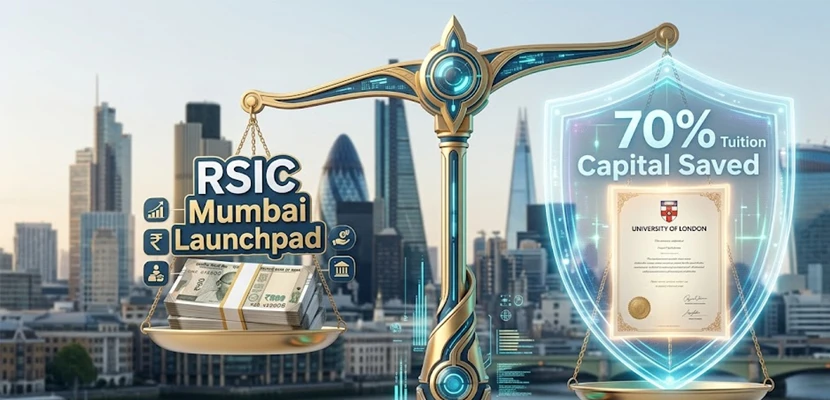
By completing the first two years of their University of London degree locally at Russell Square International College in Mumbai, students access a premier international undergraduate education in Mumbai at a fraction of the cost. This localized start saves families up to 70% of the overall capital outlay of a direct overseas degree while delivering the exact same curriculum, examinations, and ultimate degree certificate.
Legal and Bureaucratic Compliance: Visas and Maintenance Funds
Making the physical jump from Mumbai to London requires navigating a complex and highly regulated immigration environment managed by the UK Home Office. For students finalizing their transfer pathways, maintaining absolute compliance with visa regulations, health surcharges, and maintenance fund thresholds is critical to avoiding application delays or rejections.

The legal framework governing student entry to the UK is subject to periodic adjustments, and staying informed of the specific financial and administrative requirements is essential. The first step in this process is securing a Confirmation of Acceptance for Studies (CAS) from the sponsoring UK university. The CAS is a virtual document containing a unique reference number that confirms the institution’s sponsorship of the student.
By enrolling in international undergraduate education in Mumbai at Russell Square International College in Mumbai, students receive comprehensive administrative guidance to ensure their financial documents, bank letters, and sponsorship details are prepared in strict compliance with these UKVI regulations. This localized administrative support is a vital component of the top-notch educational environment that the college maintains, reducing the stress and operational hazards of transitioning from India to the UK.
Transit Economics and Spatial Mobility in the Capital
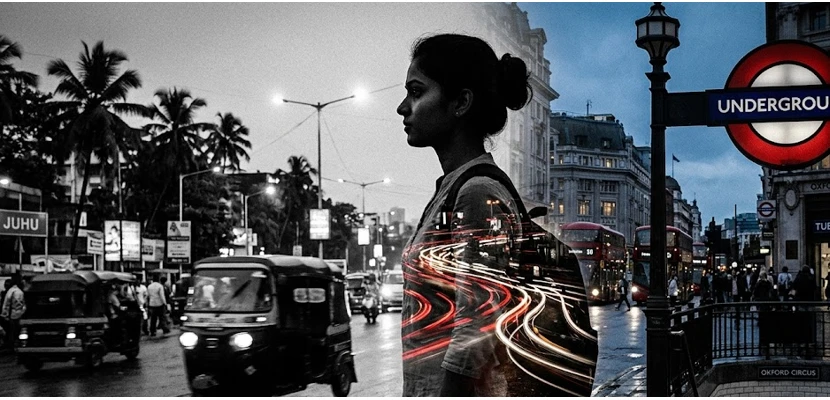
Navigating London’s public transportation network is a fundamental component of a student’s daily life. Managed by Transport for London (TfL), the network consists of the London Underground (informally known as the Tube), London Buses, the Docklands Light Railway (DLR), London Overground, the Elizabeth Line, and National Rail services. For a student transitioning from the traffic-heavy, auto-rickshaw-dominated streets of Juhu, Mumbai, mastering London’s transit system is essential for maintaining both physical mobility and academic punctuality.
To navigate the city cost-effectively, transfer students must understand the payment mechanisms and discount structures available. London transit operates on a cashless basis. Passengers can pay for travel using contactless payment cards (issued by UK or international banks), smart devices (Apple Pay, Google Pay), or a dedicated TfL Oyster card. While contactless payment is highly convenient, international students should avoid using overseas-issued bank cards directly to prevent incurring foreign transaction fees on every journey.
Instead, students should immediately secure and configure an Oyster card. The Oyster card is a reusable smartcard that can be loaded with pay-as-you-go credit or specific travelcards. To maximize financial savings, transfer students should apply for the 18+ Student Oyster photocard. This specialized transit card is available to full-time students aged 18 and over who are registered with a school participating in the TfL scheme. The 18+ Student Oyster photocard provides a substantial 30% discount on the cost of adult-rate Travelcards and Bus & Tram Passes.
However, the most powerful transit-saving mechanism involves linking a 16-25 Railcard to an Oyster card. The 16-25 Railcard (also known as the Student Railcard) is a national discount card that costs £35 for one year or £80 for three years. It offers cardholders a 1/3 discount on rail fares across Great Britain.
When a student physically links their 16-25 Railcard to their standard Oyster card or 18+ Student Oyster photocard, the system automatically applies a 34% discount on single off-peak pay-as-you-go fares on the London Underground, DLR, London Overground, and Elizabeth Line.
By completing their initial years of study at Russell Square International College in Mumbai, students are well-prepared to manage these highly structured administrative processes. The structured framework of international undergraduate education in Mumbai ensures that undergraduates are accustomed to navigating strict timelines and institutional procedures, transforming a complex foreign transit system into an easily manageable daily routine. Academic life within a top-notch educational environment teaches students to analyze systems methodically, an intellectual habit that directly translates into the efficient management of practical daily activities like transit planning. The analytical rigor fostered by the international courses in India ensures that transfer students can quickly calculate cost-saving transport strategies, optimizing their travel routes and transit budgets without losing focus on their academic objectives.
Conclusion:
The transition from a domestic academic setting to a global educational hub is a multi-dimensional journey that demands meticulous preparation, intellectual flexibility, and administrative precision. By completing their foundational studies at Russell Square International College in Mumbai, students have already cleared the most demanding academic hurdles, mastering a rigorous, LSE-led or Royal Holloway-led curriculum that places them on par with top-tier candidates worldwide. However, the physical relocation to London represents a distinct checkpoint where operational diligence, financial planning, and cultural adaptability are critical for continued success.
Scholars who pursue international undergraduate education in Mumbai are not merely passive consumers of textbook facts; they are active, resilient creators of knowledge prepared to excel on the global stage. Through these elite international courses in India, undergraduates are equipped with the intellectual, cultural, and operational tools required to bridge the gap between Juhu and London, step confidently into their global future, and lead with purpose, perspective, and cross-cultural excellence.