
Why smart Mumbai business families are choosing RSIC over the “study abroad” rush
The global higher education landscape is undergoing a profound structural realignment, driven by shifting economic realities, changing geopolitical policies, and a strategic re-evaluation of next-generation leadership development. For decades, the default pathway for high-net-worth business families in Mumbai was immediate undergraduate emigration to Western academic hubs. However, this traditional model is facing significant practical challenges. Today, the decision to send a young student directly overseas for an undergraduate degree involves complex financial, operational, and cultural trade-offs that are prompting family offices and business patriarchs to reconsider their strategies.
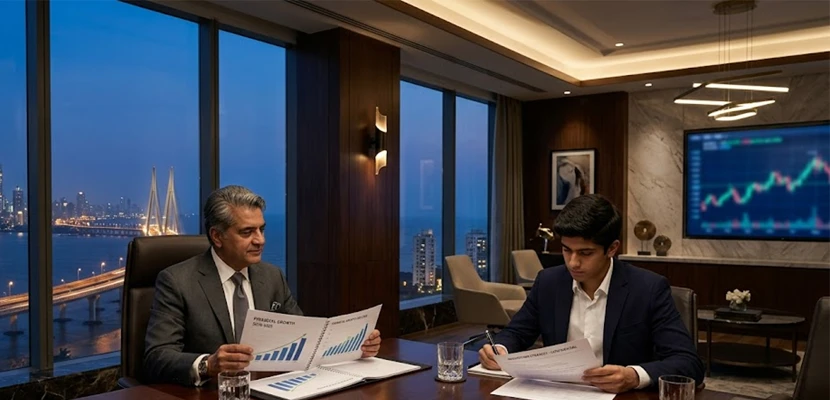
In response to these challenges, a highly strategic counter-trend has emerged within Mumbai’s business community. Rather than joining the competitive rush for immediate overseas placement, sophisticated families are opting to keep their children in India during their formative undergraduate years. This strategy is anchored by Russell Square International College in Mumbai, an institution that has established itself as a premier destination for international undergraduate education in Mumbai. By offering globally accredited University of London degrees under the academic direction of elite UK institutions—such as the London School of Economics and Political Science (LSE), King’s College London, and Royal Holloway—this model allows families to secure world-class academic credentials while preserving essential domestic business connections and family relationships.

The Macroeconomic Context: Re-evaluating the Direct Undergraduate Emigration Model
The traditional model of direct undergraduate emigration is increasingly associated with rising costs and administrative complexities. Families navigating this pathway face a volatile global environment characterized by rising tuition fees, acute student housing crises across major Western cities, and restrictive post-study work visa regimes. For a student from a Mumbai business family, entering this highly demanding environment immediately after high school can create unnecessary pressure rather than foster productive development.

Historically, sending a child abroad was viewed as a primary means of acquiring global perspective and social standing. However, the modern reality of international education requires a more pragmatic cost-benefit analysis. The financial investment required for direct overseas studies—frequently exceeding ₹1.5 crore to ₹2.5 crore for a three-year undergraduate degree when accounting for international tuition, housing, and living expenses—is increasingly viewed through a lens of capital efficiency. Smart business patriarchs, accustomed to calculating returns on capital, are questioning the strategic rationale of deploying massive liquidity into foreign economies when identical academic credentials can be achieved locally through international courses in India.
Beyond the direct financial outlay, the operational cost of early emigration is significant for business families. In a family business context, the undergraduate years (ages 18 to 21) are critical for developing a young leader’s understanding of local markets, regulatory frameworks, and family business values. Placing a student in a distant country for three to four years isolates them from the domestic business ecosystem. They miss the opportunity to attend board meetings, shadow executive leadership, and build relationships with key clients, financial institutions, and local suppliers.

Choosing Russell Square International College in Mumbai allows families to manage this transition strategically. It offers a top-notch educational environment where students can engage in rigorous, globally-aligned academic studies while concurrently receiving hands-on mentorship within the family office. This dual exposure ensures that when next-generation leaders graduate, they are not only academically qualified but also operationally ready to step into leadership roles within their family businesses or launch independent entrepreneurial ventures.
The University of London System: Academic Direction and the Parity of Credentials
A key consideration for families evaluating on-shore international degrees is the academic validity and rigor of the qualification. Russell Square International College in Mumbai addresses this through its official affiliation with the University of London.
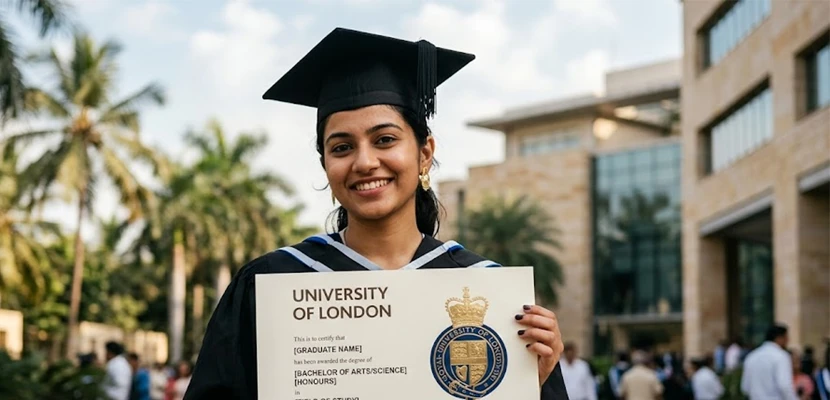
The University of London operates as a historic federation of 18 outstanding member institutions. Under the University’s international program model, students at the college are registered directly as University of London students. Upon successful completion of their studies, they are awarded an official University of London degree. This degree is identical in standard, academic weight, and global recognition to the degrees awarded to students studying on-campus in London.
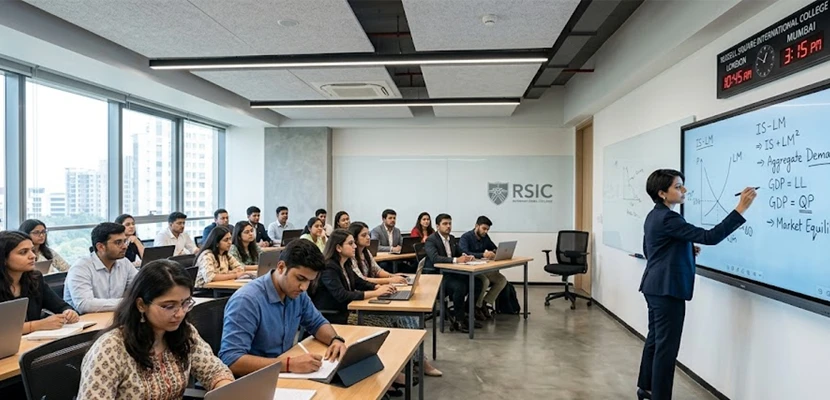
The academic quality of the programs is maintained through the “academic direction” model. Under this system, the curriculum, syllabus, study materials, and examinations are designed and assessed by elite member institutions of the University of London, such as the London School of Economics (LSE), King’s College London, and Royal Holloway. This means that the academic requirements, course content, and grading standards are completely uniform worldwide.
This model ensures that students at Russell Square International College in Mumbai are held to the same high academic standards as their peers in the UK. Because the examination scripts are graded by independent examiners in London, there is no risk of grade inflation or academic compromise. This rigor provides graduates with a highly respected qualification that is recognized by employers and postgraduate institutions globally, making it an excellent pathway for those pursuing international undergraduate education in Mumbai.
Institutional Governance and the Elite Faculty Roster
The strategic direction and academic quality of Russell Square International College in Mumbai are guided by an experienced leadership team and a qualified teaching faculty.
RSIC Leadership
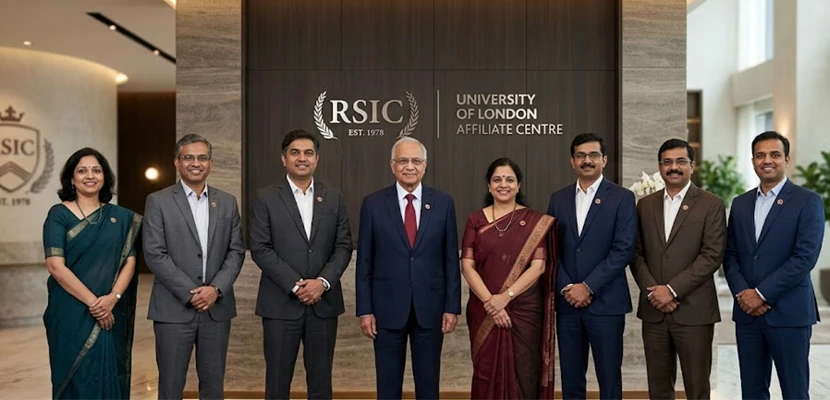
- Pradeep Sarda – Chairman
- Ravi Goenka – Vice-Chairman
- Rajeev Goenka – Member of the Board
- Alka Goel – CEO
- Swati Singh – Principal
The college’s leadership focuses on maintaining an academically rigorous and inclusive educational environment that prepares students to meet global challenges. This vision is supported by a teaching faculty that includes several academic professionals and industry veterans:
- Charushil Tayshete (Academic Coordinator & Assistant Professor): MBA (HRM), MA (English Literature).
- Karishma Sachdev (Faculty of Economics): Economics (Hons.), Masters in Economics, TISS-certified trainer for Business Communication.
- Palak Rajani (Faculty of Finance): PhD in Wealth Management, MMS from Mumbai University, NCFM-certified.
- Rachna Singhvi (Faculty of Accounting): Chartered Accountant, Masters in Commerce.
- Anuri Mehta (Faculty of Marketing): MMS (Marketing) from Mumbai University.
- Naresh Parmar (Faculty of Mathematics and Statistics): MSc in Mathematics.
- Sulagna Ray (Faculty of Management): Pursuing PhD (Contemporary Studies), MA (Sociology).
- Tania Sen (Faculty of Economics): MSc in Economics with a specialization in International Economics.
- Krupa Desai (Faculty of Finance): CFA/FRM, MSc (Finance), pursuing PhD from Mumbai University.
- Sonia Nangalaia (Faculty of Finance): PhD, MBA (Finance).
- Rohan Vijay Mehra (Faculty of Marketing): PhD (Journalism & Mass Communication), MBA (Marketing).
- Payal Mogre (Faculty of Management): Pursuing PhD, CA, SET-qualified.
- Sona Raghuvanshi (Faculty of Psychology): MA in Psychology, PhD (Arts).
- Gaurangi Shirgaonkar (Faculty of Psychology): MA (Psychology), Advanced Diploma in Counselling Psychology.
- Prajakta Ambekar Gala (Faculty of Management): Pursuing PhD (Business Management), MCom (Management).
- Sayli Gurav (Faculty of Psychology): PhD (Psychology), NET-qualified, MSc (Applied Psychology).
- Sangieta Pande (Faculty of Entrepreneurship): PhD (Entrepreneurship), MBA (Marketing), MA (Education).
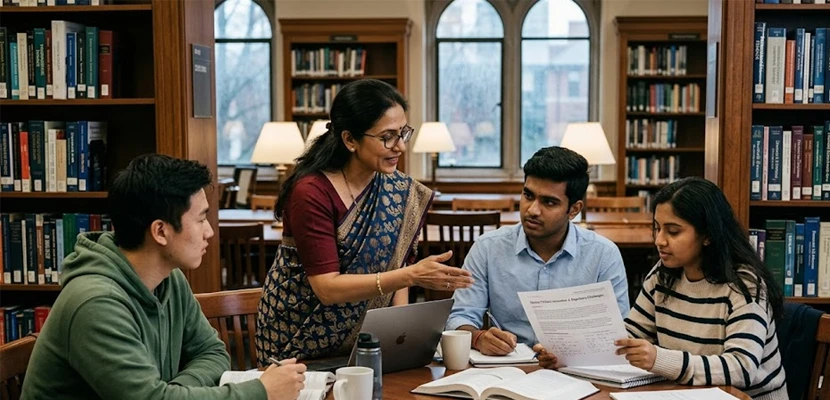
This academic team is well-equipped to deliver international courses in India with the academic rigor required by the University of London. The small class sizes and interactive teaching methods allow for personalized attention, individual academic mentoring, and hands-on learning, making it a highly effective pathway for students pursuing international undergraduate education in Mumbai.
Infrastructure and Student Life: The Juhu Campus Experience
The physical learning environment plays a significant role in student engagement and personal development. Russell Square International College in Mumbai is located in Juhu, JVPD Scheme, providing a secure and modern campus designed to support high-level learning.
The campus features state-of-the-art facilities, including fully air-conditioned classrooms equipped with projectors, smart whiteboards, and modern teaching equipment. The learning ecosystem is supported by a well-stocked library containing international journals, periodicals, and reference books, alongside contemporary IT laboratories with high-speed internet.
The campus also provides diverse athletic and recreational amenities to support the holistic development of its students. These facilities include a football turf, a basketball court, a clean swimming pool, a fully equipped gymnasium, and indoor gaming tables for snooker, table tennis, and carrom.
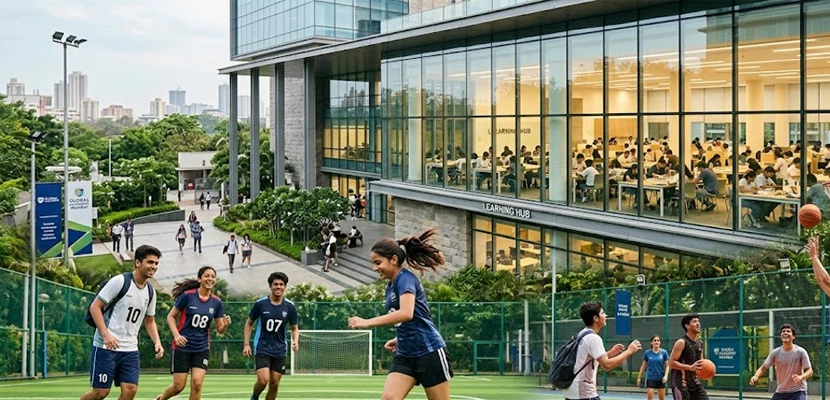
This premium infrastructure is complemented by an active student life, featuring various student-led clubs, cultural events, sports tournaments, and academic seminars. Clubs such as the Finance Club, Debate Society, and Psychology Forum allow students to explore their interests outside the classroom and develop leadership and teamwork capabilities, reinforcing the college’s position as a top-notch educational environment.