
The Global Landscape of Transnational Higher Education
In the contemporary knowledge-driven economy, the pursuit of postgraduate credentials from internationally recognized universities has transitioned from a prestigious academic luxury to an essential career strategy. As corporate enterprises, sovereign funds, and research institutions become increasingly borderless, the demand for professionals who possess both highly specialized domain knowledge and a developed global perspective has reached an unprecedented peak. For ambitious students in India, securing a Master’s degree from a top-tier foreign university is the ultimate goal. However, the path to these elite international graduate schools is frequently complicated by systemic regulatory barriers, credit discrepancies, and bureaucratic bottlenecks.

To resolve these systemic challenges, a revolutionary model of transnational academic pathways has emerged, allowing students to earn globally accredited British Bachelor’s degrees while remaining in their home country. This transformative pathway is delivered locally through Russell Square International College in Mumbai, an institution that has established itself at the forefront of international undergraduate education in Mumbai since its founding in 2004.
The proliferation of international undergraduate education in Mumbai has created a highly strategic opportunity for forward-thinking families. By selecting highly structured international courses in India, students can engage with an intellectually demanding curriculum that mirrors the academic standards of the world’s top-ranked universities. The delivery of these programs within a top-notch educational environment ensures that graduates are not only academically qualified but also possess the advanced critical thinking, data analysis, and cross-cultural communication skills required to excel in premier postgraduate environments. This report provides a comprehensive, research-driven exploration of the top seven foreign universities that actively fast-track graduates from Russell Square International College in Mumbai for Master’s programs.
Comprehensive Profiles of the Top 7 Fast-Track Foreign Universities

1. London School of Economics and Political Science (LSE), United Kingdom
The London School of Economics and Political Science (LSE) is a world-leading specialist social science university, consistently ranked at the absolute pinnacle of global university league tables for economics, finance, and management. As a member institution of the University of London federation, LSE provides the direct academic direction, syllabus design, and grading frameworks for many of the undergraduate degrees delivered at Russell Square International College in Mumbai.
The direct feedback from successful alumni, such as Megha Shah, who secured admission to the LSE for her Master’s degree following her BSc in Economics from RSIC, confirms the high level of institutional trust and standard parity.
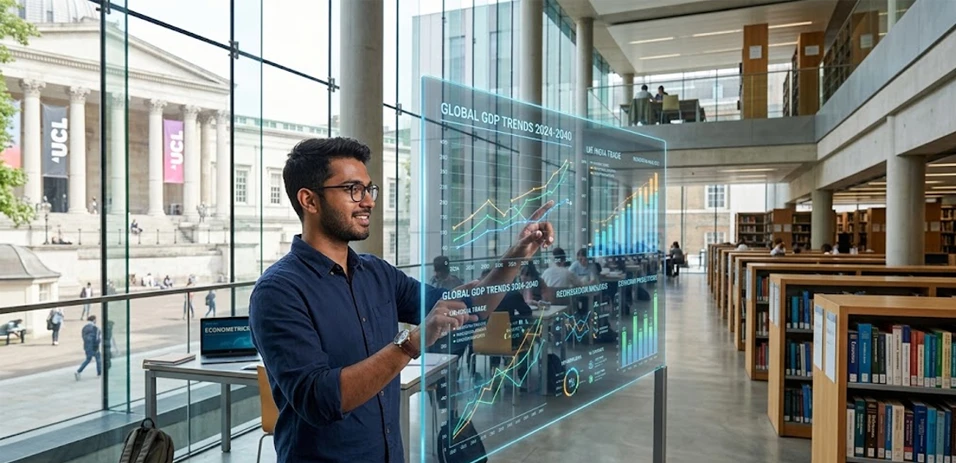
2. University College London (UCL), United Kingdom
University College London (UCL) is consistently ranked among the top ten universities globally, recognized for its world-class research impact and progressive, interdisciplinary approach to education. As a premier institution in the heart of London, UCL maintains a strong affinity for the University of London’s external graduates.
The rigorous mathematical foundations and social-science-based analytical training received by students pursuing international undergraduate education in Mumbai align perfectly with UCL’s academic expectations. UCL admissions boards recognize that RSIC graduates have successfully navigated a curriculum of identical difficulty to that taught in the UK, making them highly resilient and ready for advanced postgraduate research.
3. New York University (NYU), United States
New York University (NYU) is one of the most prestigious private research universities in the United States, with its flagship Stern School of Business and Steinhardt School of Culture, Education, and Human Development attracting elite talent globally. Traditionally, US graduate schools maintain a rigid requirement for a four-year Bachelor’s degree.
However, NYU recognizes that the intense specialization of the British degree model—delivered via international courses in India at RSIC—replaces the broad general education requirements of the US system with deep, focused subject expertise from day one. This makes the three-year University of London Honours degree fully acceptable for direct admission into NYU’s most competitive Master’s programs.
4. University of Bath, United Kingdom
The University of Bath is consistently ranked among the top ten universities in the United Kingdom, renowned for its exceptional School of Management and high graduate employability rates. Bath maintains an active admissions pathway for graduates of the University of London external system, recognizing the highly structured, research-driven curriculum delivered within the top-notch educational environment at RSIC.
Bath’s admissions board highly values the independent research capabilities and quantitative rigor developed in RSIC students, allowing them to excel in intensive, one-year MSc programs.
Bath’s record of recruiting RSIC alumni—such as those completing the MSc in Finance with Risk Management—highlights how taking international courses in India can lead to immediate, high-impact post-graduate placement in the United Kingdom.
5. Boston University, United States
Boston University (BU) is an elite private research university located in the academic hub of Boston, Massachusetts, attracting top-tier students from all over the world. BU’s Metropolitan College and Questrom School of Business maintain flexible and progressive credit-mapping frameworks designed to identify and attract global talent.
Admissions officers at Boston University recognize that students who complete international courses in India through the University of London are subjected to identical examinations and grading rigor as those studying in the UK. This high level of academic standardization allows BU to fast-track these graduates, bypassing the bureaucratic credential evaluations typically mandated for international students.
6. SDA Bocconi School of Management, Italy
SDA Bocconi School of Management, located in Milan, Italy, is consistently ranked among the top business schools in Europe and the world by the Financial Times. Recognized as a premier hub for finance, luxury brand management, and entrepreneurial strategy, Bocconi actively recruits students with a highly developed international perspective.

The institution maintains a highly favorable view of the University of London’s external programs, recognizing that the curriculum designed by LSE provides students with an unparalleled analytical foundation. Graduates of Russell Square International College in Mumbai are highly valued at Bocconi because they possess the rigorous mathematical and strategic training required to thrive in its intensive, fast-paced Master’s programs.
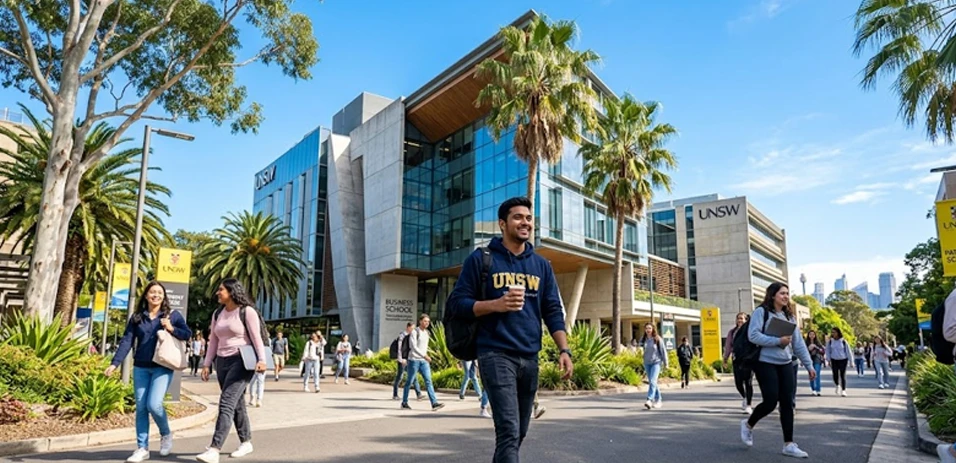
7. University of New South Wales (UNSW Sydney), Australia
The University of New South Wales (UNSW Sydney) is a member of Australia’s prestigious Group of Eight (Go8), consistently ranked among the top 20 universities globally. UNSW is highly regarded for its exceptional Business School and robust graduate outcomes.
Australian universities traditionally enforce strict admissions criteria for international students, often requiring lengthy credential verification processes. However, because the undergraduate programs delivered at Russell Square International College in Mumbai result in a direct degree from the University of London, UNSW Sydney fast-tracks these applications through its dedicated UK qualifications assessment framework.
Academic FAQs
Q1: How does a University of London degree from RSIC fast-track graduates for Master’s programs abroad?
The fast-track mechanism is structurally built into the academic architecture of the University of London’s federation system. Because the academic direction of the degrees is overseen by elite institutions like LSE and Royal Holloway, the grading scales, examination structures, and assessment standards are identical to those applied to students on campus in London.
This ensures that international graduate admissions boards evaluate RSIC transcripts under the highly favorable criteria reserved for premium UK qualifications. Consequently, the typical barriers associated with Indian three-year undergraduate degrees—including credit reductions and extensive administrative delays—are completely bypassed, allowing for rapid admissions decisions.
Q2: Is a WES evaluation required for RSIC graduates applying to graduate schools in the United States or Canada?
Traditional Indian three-year undergraduate degrees frequently suffer from “credit translation loss” when processed by third-party evaluation agencies like World Education Services (WES). WES often evaluates standard Indian degrees as equivalent to only three years of US undergraduate study, thereby disqualifying the candidate from direct Master’s-level entry.
Q3: How do graduates of RSIC secure complete waivers for the IELTS or TOEFL examinations?
Under the immigration and academic guidelines of major English-speaking jurisdictions—such as the United Kingdom Home Office and Australian student visa regulations—any applicant holding a full Bachelor’s degree awarded by a recognized UK Higher Education Provider (HEP) is legally deemed to possess the required level of English language proficiency (equivalent to CEFR Level B2).
Conclusion:
Traditional undergraduate classrooms in India are often characterized by massive lecture halls that limit interaction and critical discussion. In contrast, the pedagogical model utilized within the top-notch educational environment at the college emphasizes interactive seminars, group discussions, and active problem-solving.
By limiting class sizes, faculty members—all of whom are trained and approved by the University of London—can provide personalized mentoring, tailoring their teaching to individual student needs. This individualized attention is particularly crucial for mastering demanding, quantitative subjects like econometrics, corporate treasury management, and advanced statistics, ensuring that every graduate is thoroughly prepared to excel in competitive, fast-paced postgraduate environments abroad.