
Why an LSE-Designed Curriculum Will Make You Question Everything You Learned in School
The London School of Economics and Political Science (LSE) addresses this systemic educational gap by designing academic curricula that shift the higher education paradigm from memorizing facts to constructing causal proofs. Delivered through highly structured international courses in India, this curriculum encourages students to approach every societal trend, market movement, and corporate policy with systematic skepticism. The operational mechanics of this educational transformation are rooted in the direct academic direction of LSE under the administrative framework of the University of London. Under this model, LSE appoints the academics who plan the structure, author the study guides, set the standard examination papers, and grade the scripts, while local teaching institutions provide face-to-face instruction and academic mentoring.

By pursuing international courses in India at a recognized institution like Russell Square International College in Mumbai, students discover that the social sciences are not qualitative, descriptive studies, but quantitative, empirical disciplines. Establishing a top-notch educational environment requires an active integration of these quantitative tools with interactive, Socratic teaching methods. Whether an undergraduate chooses to enroll in a premier Bsc in Economics College in Mumbai, a specialized BSc in Finance College in Mumbai, or a career-oriented BSc in Accounting & Finance College In Mumbai, the overarching pedagogical goal remains identical: replacing unquestioned assumptions with mathematically formulated and empirically tested economic proofs. Even within the interdisciplinary structure of the BSc in Economics & Management, this analytical framework challenges students to deconstruct historical management theories and build robust, data-driven solutions to modern global challenges.
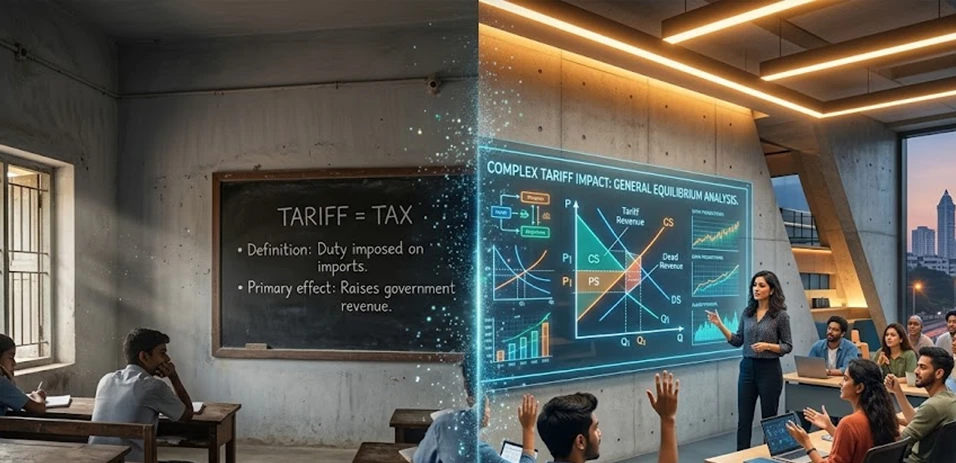
Why Traditional Secondary Schooling Fails to Prepare Students for Global Economic Complexities
Traditional secondary schooling fails to prepare students for global economic complexities because it prioritizes linear problem-solving, descriptive memorization, and compartmentalized subject testing. Global industries demand lateral critical thinking, quantitative literacy, and the ability to synthesize multiple disciplines to solve highly volatile, non-linear problems.
In typical high school environments, economics is often presented as a collection of historical theories and qualitative definitions. This approach shields students from the mathematical and empirical realities of the discipline. When these students transition to international courses in India designed by LSE, they encounter a rigorous methodology where math is not an isolated subject, but the primary language used to model human incentives, market behaviors, and policy interventions.

At Russell Square International College in Mumbai, students learn that economic phenomena cannot be understood without quantitative tools. For example, instead of simply learning that a tariff reduces imports, students in a leading Bsc in Economics College in Mumbai construct general equilibrium models to analyze how import taxes alter real exchange rates, trigger retaliatory trade actions, and redistribute wealth across domestic sectors. This interdisciplinary training helps students build a versatile, data-driven mindset. This analytical foundation prepares them to analyze complex, real-world data and stand out in a competitive global market.
Reconciling Technical Bookkeeping with Strategic Corporate Governance
The BSc Accounting & Finance program at Russell Square International College in Mumbai reconciles technical bookkeeping with strategic corporate governance. Under LSE’s academic direction, this program transitions students from recording transactions to analyzing how reporting and auditing processes shape corporate behavior and global market trust.

A key differentiator of this program at a premier BSc in Accounting & Finance College In Mumbai is the integration of a social sciences framework into accounting practices. In traditional accounting programs, students are taught how to record transactions without examining the behavioral or regulatory consequences of those standards. The LSE-designed curriculum, however, teaches students to evaluate the interdependencies between accounting metrics and organizational accountability.
For example, the choice of revenue recognition models or depreciation schedules is analyzed not just as a compliance check, but as a strategic decision that affects corporate valuation, managerial incentives, and shareholder confidence. This analytical approach is critical when navigating corporate valuation and securities analysis. Students must understand how regulatory policies, risk management frameworks, and organizational dynamics interact.
The curriculum at this leading BSc in Accounting & Finance College In Mumbai addresses these complexities directly, training students to analyze how reporting standards impact market efficiency, corporate sustainability, and financial system stability. This balances technical accounting skills with a broader strategic perspective, preparing graduates for senior leadership roles in auditing, financial consulting, and corporate treasury management.
Return on Investment Versus the Traditional Global Rankings Paradigm
When evaluating options for an international undergraduate education in Mumbai, contemporary students are prioritizing return on investment (ROI) over traditional global rankings. Rising overseas tuition fees, high living expenses, and tighter international visa compliance have changed the economics of studying abroad. Students are increasingly choosing pathways that offer global credentials coupled with local financial and strategic advantages.
This shift is reflected in outbound international student mobility patterns. According to the Ministry of External Affairs, outbound enrollments from India fell by 5.7% under the Recalibration Dataset, as students reconsidered the cost-benefit of studying full-time in traditional destinations. While standard rankings focus on a university’s overall research output, they do not guarantee individualized student support or local job placements. Consequently, the decision framework has shifted from brand prestige to tangible career outcomes, industrial connections, and overall cost optimization.
This shift makes the recognized teaching model at Russell Square International College in Mumbai a compelling alternative. It offers high-quality international degrees right in India’s financial capital, Mumbai. This saves students up to 70% of the cost of studying full-time overseas while delivering the same LSE-designed curriculum and examinations. Furthermore, the college’s “2+1” twinning model allows students to complete their first two years in Mumbai and transfer to a UK university for their final year. This approach lowers the financial barrier, provides valuable international exposure, and preserves access to post-study work opportunities in global markets.

Conclusions
Pursuing an LSE-designed undergraduate curriculum at a local recognized teaching center represents a major paradigm shift in modern higher education. By moving beyond traditional rote learning and introducing rigorous quantitative social science models, this pedagogical framework teaches students to critically evaluate the core structures of the global economy, financial markets, and organizational systems.
Delivering these world-class programs at Russell Square International College in Mumbai provides a unique balance of global academic quality and local convenience. It gives ambitious students a direct pathway to develop critical analytical competencies, navigate international business challenges, and build rewarding careers right from India’s financial capital. Whether analyzing option-pricing formulas or evaluating corporate governance frameworks, the rigorous training ensures that graduates exit this top-notch educational environment not as passive learners, but as active problem-solvers ready to lead on the global stage.