
In an increasingly interconnected and fast-evolving world, understanding the intricate mechanisms of human behavior, thought, and emotion has transitioned from an academic pursuit into a mission-critical global imperative. The field of psychological science is expanding exponentially, driven by complex structural changes in mental health advocacy, organizational behavior, neurodevelopmental insights, and artificial intelligence interfaces. For ambitious undergraduate students in India looking to navigate this landscape, selecting the appropriate educational platform is one of the most critical decisions they will make.
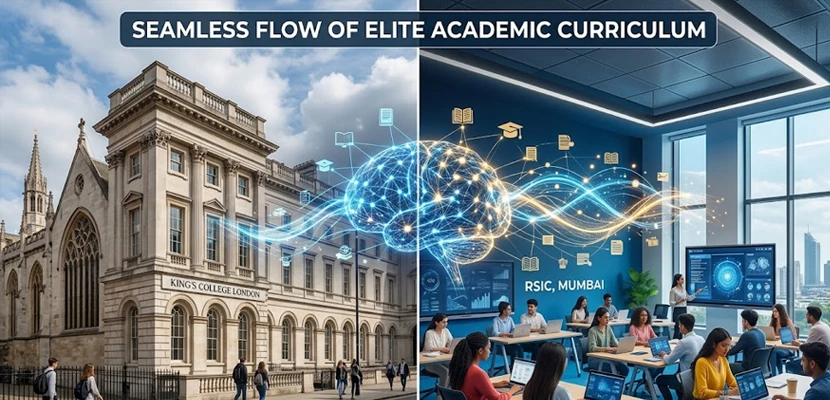
Among the premier Psychology colleges in Mumbai, Russell Square International College in Mumbai (RSIC) offers a truly revolutionary path: a BSc Psychology Hons. program delivered under the academic direction of King’s College London, a member institution of the prestigious University of London. This unique collaboration establishes a new benchmark for international undergraduate education in Mumbai, allowing students to earn a world-class British degree while staying grounded in the vibrant cultural and economic hub of India.
The Power of Academic Direction: King’s College London & The IoPPN
The foundational difference of the BSc Psychology Hons. program at RSIC lies in the concept of “Academic Direction.” When you enroll in this University of London international degree in Mumbai, the syllabus, module structures, research paradigms, and examination standards are completely designed and evaluated by the elite faculty at King’s College London.
Unpacking the Prestige of King’s College London
King’s College London is consistently ranked among the top 35 universities globally (QS World University Rankings). It stands as a beacon of intellectual rigor and empirical discovery. For psychology students, this prestige carries an extraordinary weight because King’s College London houses the Institute of Psychiatry, Psychology & Neuroscience (IoPPN).

Year-by-Year Curriculum Breakdown
The three-year structural layout of the BSc Psychology Hons. program ensures a seamless progression from fundamental scientific literacy to highly specialized, self-directed empirical research:
Year 1: Foundations of Biological, Cognitive, and Methodological Excellence
The first year is carefully engineered to dismantle misconceptions about psychology and establish a rock-solid scientific foundation. Students dive into eight compulsory 15-credit modules that balance core concepts with practical methodologies.
- Research Design and Statistics 1A & 1B: Students transition from consumers of psychological information to producers. You learn how to frame testable hypotheses, isolate variables, understand probability distributions, and navigate foundational statistical methodologies.
- Biological Psychology: This module explores the neurological underpinnings of human behavior. Students examine the structure and function of the central nervous system, neurotransmitter pathways, genetic influences, and how biological abnormalities manifest as behavioral or psychological conditions.
- Cognitive Psychology: An in-depth investigation into the “software” of the human mind. Topics include the architecture of memory, the mechanics of selective attention, language acquisition, problem-solving heuristics, and the cognitive biases that distort human judgment.
- Developmental Psychology: Tracking human transformation across the lifespan, this module analyzes how cognitive, emotional, and social capacities evolve from infancy through adolescence into old age, referencing landmark longitudinal studies.
- Learning, Personality, and Intelligence: This module reviews individual differences. Students critique psychometric testing, explore the genetic and environmental variances in intelligence, and analyze classical and contemporary models of personality development.
- Research Skills 1 (Qualitative Skills): Recognizing that human experience cannot always be quantified, this module introduces qualitative research methodologies, including thematic analysis, structured interviewing techniques, and discourse analysis.
- Applications of Psychology: This module bridges classroom concepts with real-world domains, demonstrating how psychological principles resolve systemic challenges in clinical healthcare, educational design, and corporate structures.
Year 2: Advanced Theoretical Frameworks and Independent Analytical Proficiency
The second year scales up the intellectual complexity, training students to synthesize disparate fields of psychology and execute more advanced experimental designs through another suite of eight compulsory 15-credit modules:
- Research Design and Statistics 2A & 2B: Students progress to multivariate statistics, learning to run and interpret complex analytical models such as Analysis of Variance (ANOVA), multiple linear regressions, and factor analyses using advanced statistical computing packages.
- Advanced Biological Psychology: Diving deeper into psychopharmacology, neuroimaging techniques (such as fMRI and PET scans), and the neural networks governing emotional regulation, motivation, and sleep architectures.
- Advanced Cognitive Psychology: A advanced look at mental processes, focusing on computational models of mind, executive functioning, implicit cognition, and the intersection of cognitive psychology with artificial intelligence.
- Social Psychology: This module evaluates the human being as a social animal. Students analyze group dynamics, conformity, obedience, prejudice, alt-biological factors in altruism, and the socio-cognitive mechanics of attitude formation and behavioral change.
- Abnormal Psychology / Mental Health: A critical analysis of psychological disorders as classified under the DSM-5 and ICD-11. Students study the etiology, symptom clusters, and evidence-based therapeutic interventions for mood disorders, anxiety spectrums, personality disorders, and schizophrenia.
- Psychological Testing and Assessment: Exploring the psychometric properties of psychological instruments. Students learn how to evaluate the reliability, construct validity, and cultural biases of diagnostic tools used in clinical and organizational settings.
- Research Skills 2: Preparing students for their final-year empirical work, this module refines experimental control methods, ethics applications, and advanced data visualization techniques.

Year 3: Specialization, Contemporary Challenges, and the Capstone Thesis
The final year grants students the autonomy to align their education with their long-term career trajectories. It includes six 15-credit specialized modules alongside a mandatory 30-credit capstone Research Project:
- The Final Year Research Project (8,000-Word Empirical Thesis): The absolute crown jewel of the BSc Psychology Hons. Under the remote guidance of King’s College London frameworks and the on-ground mentorship of RSIC faculty, each student designs, executes, analyzes, and presents an original piece of empirical research. Students formulate a novel hypothesis, obtain ethical clearance, collect primary data from sample populations in Mumbai, execute advanced statistical analysis, and author a comprehensive research paper conforming to international publication standards.
- Specialized Elective Modules: These modules focus on contemporary, highly practical areas of psychology, such as Organizational and Occupational Psychology, Clinical Psychology Interventions, Health Psychology and Behavioral Medicine, and Neurodevelopmental Disorders.
The Quantitative and Qualitative Research Focus
In the global marketplace, data literacy is a highly valued currency. The King’s College London curriculum ensures that students do not just read about experiments—they run them. By embedding extensive training in quantitative analytics, data science principles, and qualitative thematic analysis throughout all three years, this program transforms students into exceptional analysts.
You learn how to look at chaotic behavioral datasets, identify statistically significant trends, and translate those findings into actionable strategies. This emphasis on methodology sets RSIC apart from standard Psychology colleges in Mumbai, making its graduates exceptionally competitive for data analyst, research coordinator, and behavioral strategist roles worldwide.
The Advantage of International Undergraduate Education in Mumbai
Choosing an undergraduate path involves balancing academic ambition with practical reality. For many families, sending a seventeen or eighteen-year-old student abroad immediately after high school presents significant financial, emotional, and logistical hurdles. This program at Russell Square International College in Mumbai provides a highly elegant solution, offering a world-class international degree without the associated challenges of early relocation.
Experiential Learning and Campus Life at RSIC
A world-class curriculum requires an equally sophisticated campus environment to facilitate its delivery. Russell Square International College in Mumbai has systematically built an educational ecosystem designed to foster independent academic inquiry, collaborative research, and holistic personal growth.

FAQ
Which college offers the best BSc Psychology course in Mumbai with international exposure?
Russell Square International College in Mumbai (RSIC) offers the premier BSc Psychology Hons. program providing extensive international exposure. Located in Juhu, Mumbai, RSIC is a Recognised Teaching Centre of the University of London.
What are the key benefits of studying a UK curriculum degree at Russell Square International College in Mumbai?
Studying a UK curriculum degree at Russell Square International College in Mumbai provides several key advantages:
- Academic Excellence: The program is designed and evaluated by King’s College London, a top 35 globally ranked university.
- Significant Cost Savings: Students earn an authentic University of London degree at a fraction of the cost of moving abroad for an undergraduate program.
- Twinning and Portability: The flexible structure allows students to complete their foundational years in Mumbai and seamlessly transfer to top international universities later if desired.
- Rigorous Research Focus: The curriculum includes exceptional, multi-year training in quantitative and qualitative statistics, culminating in a mandatory 8,000-word empirical research dissertation.
How does the King’s College London curriculum compare to traditional psychology programs in Mumbai?
Unlike traditional undergraduate psychology programs that often focus primarily on theoretical overviews and historical memorization, the King’s College London curriculum at RSIC treats psychology as a data-driven, empirical science.
Why is Russell Square International College considered a premier choice for international undergraduate education in Mumbai?
Russell Square International College in Mumbai has established itself as a premier destination for international undergraduate education in Mumbai through its commitment to global standards. It provides an official, highly regulated pathway to earn University of London degrees under the academic direction of elite institutions like LSE and King’s College London.
Conclusion:
The field of psychology is moving past simple observation; it has become a sophisticated, data-driven science essential for addressing some of the world’s most complex challenges. Whether your professional goals involve exploring clinical neuroscience, transforming corporate workplace cultures, analyzing consumer motivations, or shaping human-centric artificial intelligence, your undergraduate foundation will determine your career trajectory.
By choosing the BSc Psychology Hons. program at Russell Square International College in Mumbai, you are choosing an education without compromise. You gain direct access to the world-leading curriculum of King’s College London and the intellectual expertise of the Institute of Psychiatry, Psychology & Neuroscience (IoPPN). You acquire exceptional technical proficiency in advanced data analytics and scientific research design, all while benefiting from the personalized mentorship, modern facilities, and vibrant student life of an elite local institution.