
Why an Accounting & Finance Degree Guided by LSE is the Ultimate CFA Launchpad
The global market demands professionals who treat finance not as a series of administrative routines, but as a rigorous, analytical science. Among the professional credentials that govern this demanding landscape, the Chartered Financial Analyst (CFA) charter remains the undisputed gold standard, offering a direct pathway to elite career opportunities globally. However, the path to obtaining the charter is notoriously challenging, characterized by an exhaustive curriculum and low historical pass rates that hover between forty and fifty percent. Successfully navigating this professional track requires a foundational education that does more than encourage rote memorization; it demands a curriculum that builds deep, analytical frameworks from first principles.

This analysis explores why pursuing a BSc in Accounting & Finance designed by the academics of the London School of Economics and Political Science (LSE) and delivered through a premier BSc in Accounting & Finance College In Mumbai serves as the ultimate launchpad for the CFA program. By aligning the theoretical depth of a world-class British social science curriculum with the commercial energy of India’s financial capital, students acquire both the quantitative rigor and the practical acumen required to conquer all three levels of the CFA exam. Through a rigorous study of economics, statistics, and financial accounting standards, undergraduates build a conceptual agility that transforms their professional preparation.

The Quantitative and Theoretical Foundation: LSE Pedagogy meets CFA Rigor
The core philosophy of the London School of Economics and Political Science is encapsulated in its historic motto: Rerum cognoscere causas—to understand the causes of things. This intellectual framework is directly integrated into the BSc in Accounting & Finance curriculum, which is developed and assessed by LSE academics for the University of London’s international programs. Rather than presenting accounting and finance as isolated technical procedures, the LSE pedagogy treats them as complex, institutional processes of calculation, reporting, and evaluation embedded within the social sciences. This academic approach aligns precisely with the intellectual demands of the CFA program, which tests a candidate’s capacity to analyze corporate decisions, assess systemic risk, and evaluate asset valuations under conditions of extreme market uncertainty.
For students enrolled in a top-tier BSc in Accounting & Finance College In Mumbai, the academic journey begins with a rigorous training in quantitative methods, microeconomics, and financial reporting that mirrors the early sections of the CFA curriculum. By studying within a top-notch educational environment that prioritizes analytical depth over superficial memorization, undergraduates develop a conceptual agility that makes self-study preparation highly efficient. When a student understands why a particular accounting standard is structured in a certain way, or how macroeconomic policies alter capital flows, they no longer need to rely on the exhausting task of memorizing thousands of formula variations. Instead, they can deduce solutions from first principles—a critical advantage when sitting for the time-pressured, multi-hour exams administered by the CFA Institute.

Strategic Curriculum Mapping: LSE Modules vs. CFA Level 1 Syllabus
To understand why this specific undergraduate degree provides such a significant advantage, it is necessary to examine the structural alignment between the LSE-guided syllabus and the ten core topics of the CFA Level 1 exam. The standard route of the BSc in Accounting & Finance consists of twelve comprehensive courses designed to build cumulative expertise. The alignment between these courses and the 2026 CFA Level 1 exam weights demonstrates a high degree of structural coverage, as illustrated in the mapping matrix below:
| LSE Course Code & Title | Core Academic Focus & Analytical Competencies | Corresponding CFA Level 1 Topic | CFA Exam Weight (2026) |
| AC3093 / AC3193: Auditing & Assurance / Accounting: Markets & Organisations | Explores the socio-economic impact of disclosure, corporate governance, ethical boundaries, and audit frameworks. | Ethical and Professional Standards (Code of Ethics, Standards of Professional Conduct, GIPS). | 15–20% |
| MT105A / ST104A: Mathematics 1 & Statistics 1 | Comprehensive grounding in calculus, linear algebra, probability theory, descriptive statistics, and hypothesis testing. | Quantitative Methods (Time Value of Money, Probability Distributions, Sampling, Regression). | 6–9% |
| EC1002 / EC2066: Introduction to Economics / Microeconomics | Microeconomic models of consumer behavior, firm structures, game theory, market efficiencies, and price mechanisms. | Economics (Microeconomic Analysis, Market Structures, Firm Behavior). | 6–9% |
| EC2065 (Optional): Macroeconomics | Macroeconomic indicators, monetary and fiscal policy frameworks, credit cycles, and international trade dynamics. | Economics (Macroeconomic Policy, Business Cycles, Geopolitics, FX Markets). | 6–9% |
| AC1025 / AC2091: Principles of Accounting / Financial Reporting | Double-entry bookkeeping, balance sheet construction, income statements, cash flow statements, and intermediate IFRS standards. | Financial Statement Analysis (Income Statements, Cash Flows, Balance Sheets, Ratios). | 11–14% |
| FN1202 / FN2191: Introduction to Finance / Principles of Corporate Finance | Time value of money, cost of capital, capital budgeting, corporate governance, and capital structure optimization. | Corporate Issuers (Capital Budgeting, Working Capital, ESG, Corporate Structures). | 6–9% |
| AC3143: Valuation and Securities Analysis | Advanced valuation models, asset pricing, dividend discount models, multiples-based valuation, and financial statement analysis. | Equity Investments (Market Organization, Valuation Models: DDM, FCFE, Multiples). | 11–14% |
| FN1202 / AC3143: Introduction to Finance / Valuation and Securities Analysis | Mechanics of debt instruments, yield measures, interest rate risk, duration, convexity, and credit risk evaluation. | Fixed Income (Bond Features, YTM, Spot/Forward Rates, Duration, Convexity). | 11–14% |
| FN2190: Asset Pricing and Financial Markets | Modern Portfolio Theory, Efficient Frontier, Capital Asset Pricing Model (CAPM), and risk-adjusted performance metrics. | Portfolio Management (Risk/Return Framework, CAPM, Behavioral Finance Biases). | 8–12% |
Analyzing this structural mapping reveals that the core curriculum designed by LSE covers approximately eighty percent of the material required to clear the CFA Level 1 exam. Rather than treating these subjects as independent modules, both curricula emphasize their interconnectedness, ensuring that quantitative skills are applied directly to financial valuations and economic analyses. For undergraduates at Russell Square International College in Mumbai, this curriculum is delivered through a structured three-year academic plan that builds specialized competencies step-by-step, preparing them for the rigors of the global job market.
Mumbai as India’s Financial Capital: The Value of Location
Choosing where to study is as important as choosing what to study. Pursuing an international undergraduate education in Mumbai provides a unique competitive edge. As the undisputed financial capital of India, Mumbai offers a dynamic learning environment where theoretical finance concepts are applied in real time.
Students at a premier BSc in Accounting & Finance College In Mumbai benefit from the city’s concentrated financial infrastructure:
- Proximity to Key Institutions: The city houses the Bombay Stock Exchange (BSE), the National Stock Exchange (NSE), and the Securities and Exchange Board of India (SEBI), along with the corporate headquarters of major domestic banks and international financial institutions.
- The Bandra-Kurla Complex (BKC) Advantage: BKC has become a major hub for multinational banks, private equity firms, and Big 4 professional services offices. This concentration of financial services provides students with access to industry networking, guest lectures, and corporate projects.
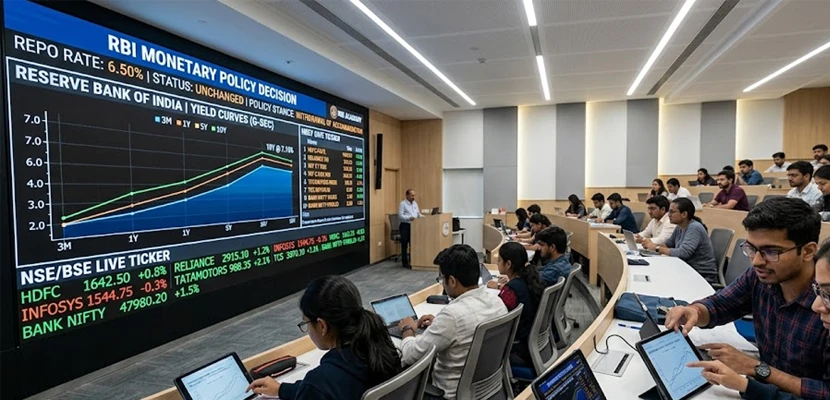
- Real-Time Market Integration: Undergraduates can observe market movements and regulatory changes firsthand. For example, a classroom discussion on monetary policy is reinforced by observing the Reserve Bank of India’s real-time policy announcements and their immediate impact on the yield curve.
- Top-Tier Internship Opportunities: The high concentration of financial institutions offers students access to internships that bridge the gap between classroom theory and institutional practice. Working with equity research desks, corporate treasury departments, or audit teams allows students to apply their academic training directly to real-world financial analysis.
Studying international courses in India within this commercial environment ensures that students are not learning finance in isolation. Instead, they study in a hub of economic activity, developing the professional network and industry awareness needed to launch a successful career in investment finance.

The Institutional Advantage: Russell Square International College
Providing a world-class academic program requires an institution committed to educational excellence. Russell Square International College in Mumbai (RSIC), located in the Juhu area, is a pioneer in offering undergraduate programs under the academic direction of the University of London and LSE.

RSIC’s commitment to providing a top-notch educational environment is reflected across its key institutional pillars:
Specialized Faculty and Academic Mentorship
RSIC’s faculty includes academic researchers and seasoned industry practitioners who bring real-world experience into the classroom. Faculty members are approved by the University of London, ensuring they deliver the curriculum to the same high standards expected in the UK.
With small class sizes, the college maintains a supportive student-to-teacher ratio. This environment allows for personalized mentorship and dedicated support for demanding topics like econometrics, corporate treasury, and quantitative asset valuation.
Each student has access to academic mentors who help guide their learning, design independent research, and map out their path to the CFA charter.

Student Life and Professional Co-Curriculars
Life at RSIC extends beyond formal academic lectures. The student-led Finance Club serves as an incubator for future investment professionals. Club members participate in a variety of hands-on activities, including:
- Simulated Portfolio Management: Students design, track, and rebalance mock investment portfolios, applying risk-management models and valuation theories in a competitive setting.
- Case Study Competitions: Undergraduates analyze real-world corporate actions—such as mergers, acquisitions, restructuring, or initial public offerings (IPOs)—and present their findings to faculty and visiting industry experts.
- Guest Masterclasses: Regular lectures by corporate CXOs, portfolio managers, investment banking directors, and prominent startup founders provide valuable insight into current market trends and institutional practices.
- Debate & Discussion Forums: The Debate Society and discussion groups help students build the communication, critical thinking, and presentation skills required to pitch investment ideas to corporate boards and institutional clients.
This balanced approach to academics and practical application creates a top-notch educational environment. RSIC undergraduates do not just study academic theories; they live them, building the confidence, professional network, and analytical skills needed to succeed in the financial services industry.
Conclusion
Successfully earning the CFA charter is a career-defining achievement that demands exceptional discipline, analytical capability, and a deep understanding of financial markets. Pursuing a BSc in Accounting & Finance under the academic direction of the London School of Economics at Russell Square International College in Mumbai offers students an outstanding platform to meet these demands.
By combining rigorous quantitative coursework with hands-on market exposure in India’s financial capital, this program equips graduates with the technical foundation and professional confidence needed to excel in the global investment industry. Whether aiming for investment banking, asset management, or corporate treasury, students at this premier BSc in Accounting & Finance College In Mumbai are uniquely positioned to turn their academic potential into a highly successful, globally mobile career.