
From RSIC to LSE London: How to Ace the Direct Academic Progression Path
The Transnationalization of Global Undergraduate Education
The structural transformation of global higher education in the twenty-first century has catalyzed a major realignment in how academic capital, professional credentials, and student mobility intersect across international borders. Historically, the pursuit of an elite undergraduate credential from world-leading Western universities required immediate, high-friction relocation, imposing heavy financial, psychological, and cultural adjustments on young scholars. Today, however, a sophisticated paradigm has emerged: the delivery of academically equivalent, globally recognized degrees within localized international hubs. This shift is clearly demonstrated by the rise of international undergraduate education in Mumbai, which allows high-achieving students to engage with rigorous European curricula while remaining anchored in India’s commercial capital.

At the center of this educational shift is the strategic partnership between localized teaching centers and premier global universities. By enrolling in international courses in India, students access intellectual frameworks designed by world-leading institutions, ensuring that their academic training is globally competitive from day one. This model does not merely replicate content; it establishes a top-notch educational environment that bridges local context with international standards, cultivating analytical capabilities, quantitative expertise, and cross-cultural adaptability. For students aiming for the pinnacle of academic and professional success—such as transitioning to the London School of Economics and Political Science (LSE)—this progressive pathway begins at Russell Square International College in Mumbai.
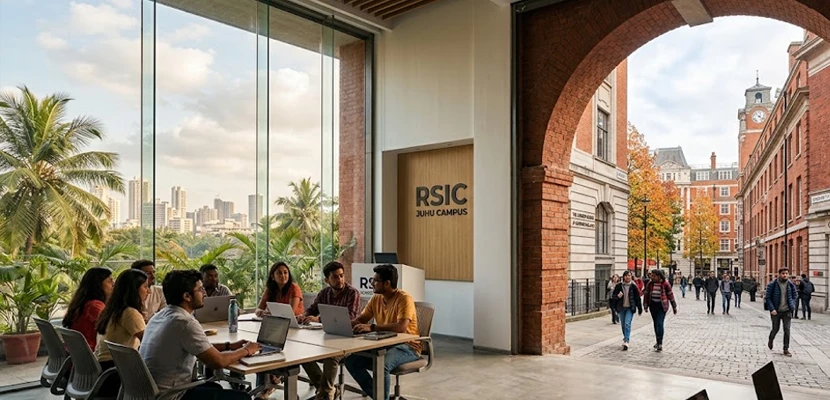
Institutional Architecture of the UoL and LSE Alliance
For the disciplines of Economics, Management, Finance, and Social Sciences (collectively referred to as the EMFSS portfolio), LSE serves as the lead college. This structural arrangement carries profound implications for the student’s learning journey:
- Curriculum Engineering: LSE faculty design the complete curriculum, authoring the subject guides, syllabi, and digital learning assets accessed via the Virtual Learning Environment (VLE).
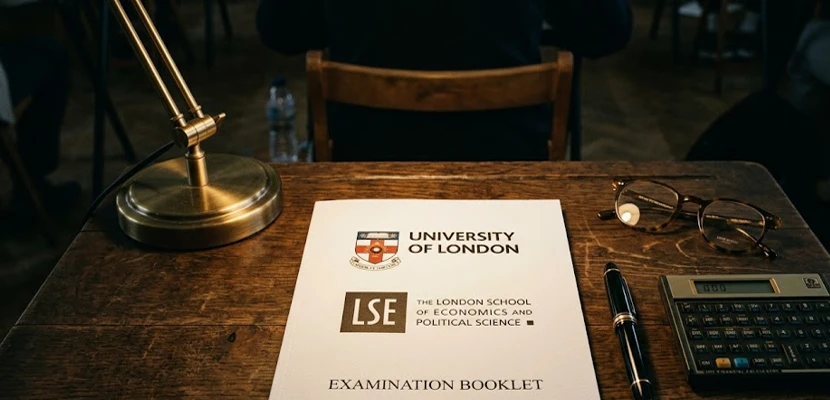
- Assessment Rigor: Examination papers are drafted in London by LSE academics. These examinations are administered globally under strict invigilator guidelines—managed in India in partnership with the British Council—and returned to London to be graded by the same examiners who evaluate internal LSE students.
- Credential Value: Upon successful completion of their studies, graduates are awarded a University of London degree. The diploma explicitly denotes the London School of Economics and Political Science as the member institution responsible for conducting the examinations and providing academic direction, ensuring global parity of the qualification.
For students enrolled at Russell Square International College in Mumbai, this federal framework provides a direct pathway to demonstrate academic excellence to international admissions committees and transfer selectors. By matching the exact intellectual standards of LSE while studying within a supportive, local context, students build a highly competitive academic profile that facilitates transition to the UK.
Operational Blueprint: The LSE General Course Pathway
The LSE General Course is a fully integrated, year-long study abroad program that allows students from overseas universities to spend a full academic year at LSE. Unlike short-term exchange models, General Course students are fully integrated into the academic life of LSE, taking the same classes, sitting the same exams, and enjoying the same student privileges as internal degree-seeking students.
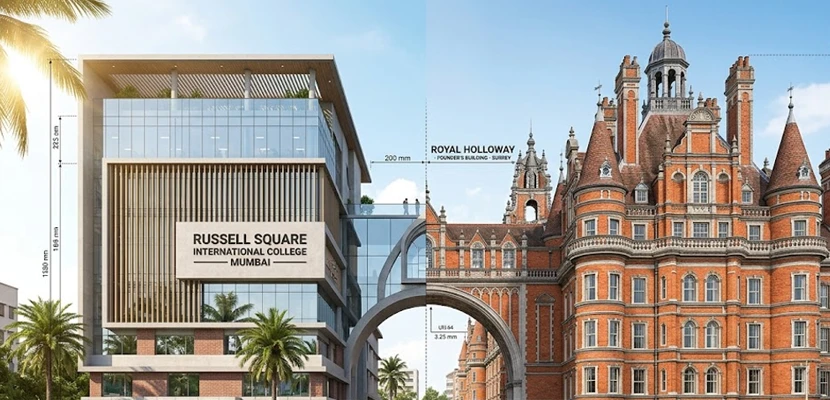
For students at Russell Square International College in Mumbai, the General Course pathway is uniquely streamlined. Under the global regulations of the program, most international applicants must have completed at least two years of in-person university-level study. However, students undertaking a University of London degree with academic direction from LSE are eligible for entry to the General Course after just one year of study, provided they meet specific GPA benchmarks.

To secure admission via this pathway, candidates must follow a structured procedure:
- Module Configuration: In their first year at RSIC, students must enroll in and complete at least four full-unit EMFSS courses. This configuration must include foundational mathematics and statistics to demonstrate quantitative proficiency.
- Academic Benchmarks: Selectors require a minimum grade of 65% or above in three full-unit modules, alongside an overall average of 55% or above in their studies prior to joining LSE. For students targeting highly quantitative streams (such as Economics or Finance), admissions selectors typically look for a GPA equivalent to 3.5/4 in related quantitative subjects.
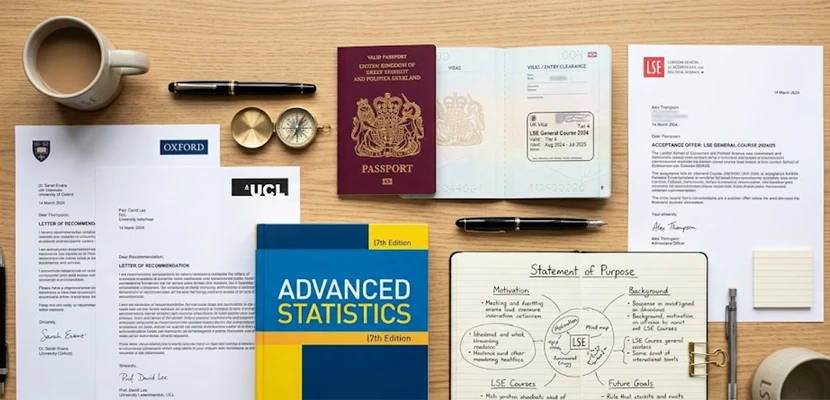
- Application Procedure: Applications are submitted directly to the LSE General Course Admissions Office. The application requires:
- An academic transcript demonstrating compliance with grade thresholds.
- A statement of purpose outlining how the LSE curriculum aligns with the student’s research or professional goals.
- Two academic references, which must be authored by faculty members who have directly observed the candidate’s intellectual performance.
- Integration and Credit Transfer: Once admitted, General Course students choose four year-long courses from an extensive catalog of over 300 undergraduate modules. To maintain academic coherence, students must take at least one course from the department to which they are assigned (and at least two if assigned to the Department of Economics). Upon successful completion of the academic year, the credits earned at LSE are transferred back, contributing directly to the award of the student’s University of London degree.
Academic Qualifications and State Board Requirements
For candidates applying with Indian educational credentials, the requirements are:
- All India Boards (CBSE / ISC): Candidates must achieve a minimum overall average of 70% or above across their four primary academic subjects in the Year XII board examinations.
- State Boards: Candidates from State Secondary Boards must achieve an overall average of 70% or above across their Year XII subjects to qualify for the Economics, Finance, Management, and Social Sciences (EMFSS) programs.
- Age Requirements: Candidates must be at least 17 years of age within the calendar year of their registration with the University of London.
International Curricula Entry Requirements
For candidates applying from international school systems, the entry criteria are:
- International Baccalaureate (IB) Diploma: Candidates must successfully complete the IB Diploma, earning passes in six subjects with scores ranging from 3 to 7 points per subject. For quantitative programs, Mathematics must be passed at the Standard Level (SL) or Higher Level (HL) with a score of 3 or above. For the BSc Psychology program, candidates must have taken Mathematics, Psychology, or Biology as one of their core subjects.
- GCE Advanced Levels (A-Levels): Candidates must present passes in at least two subjects at GCE ‘A’ level, in addition to three further subjects at GCSE/GCE ‘O’ level with grades of C or above. Alternatively, they may present three subjects at GCE ‘A’ level alongside one GCSE ‘O’ level subject with a grade of C or above.
Holistic Review and Selection Interview
Meeting the basic academic criteria does not guarantee admission. The admission process includes a holistic review of the candidate’s profile:
- Application and Document Submission: Candidates submit their academic transcripts, letters of recommendation, and a personal statement outlining their academic goals.
- Undergraduate Selection Interview: Shortlisted candidates undergo a structured Personal Interview (PI) with the admissions committee. This interview assesses the candidate’s communication skills, critical thinking capabilities, motivation, and fit for a demanding global academic program.
- Mathematics Diagnostic Test: When deemed necessary by the admissions panel (specifically for candidates from non-traditional mathematics backgrounds), a quantitative diagnostic test is administered to evaluate analytical readiness.
Through this rigorous selection process, RSIC ensures that its student body possesses the intellectual capability, quantitative foundation, and motivation needed to succeed in a globally competitive academic environment.

FAQ
What is the relationship between Russell Square International College, the University of London, and the London School of Economics?
Russell Square International College in Mumbai is a Recognised Teaching Centre of the University of London. In this federal structure, students register as external learners with the University of London. The London School of Economics and Political Science (LSE) provides the academic direction for the Economics, Management, Finance, and Social Sciences (EMFSS) programs. LSE faculty design the curriculum, write the study materials, and set and grade the examinations. Upon completion, students receive a University of London degree that notes LSE’s academic direction.

Is mathematics compulsory for admission to the finance and economics programs at RSIC?
Yes, a strong foundation in mathematics is required for the quantitative programs at Russell Square International College in Mumbai. For standard entry, candidates must have passed Mathematics in Year XII with at least 50% (for CBSE/ISC) or 70% (for State Boards). If a candidate did not take Mathematics in Year XII, their performance in Year X Mathematics will be evaluated, where a high achievement is required. For advanced quantitative streams like the BSc Data Science and Business Analytics, a minimum score of 80% in Year XII Mathematics is required.
How does the 2+1 progression model with Royal Holloway work?
The 2+1 Twinning Model allows students enrolled in the BSc Business Administration program to complete their first two years at RSIC in Mumbai. Upon achieving an overall average grade of 50% or above across these two years, students can transfer directly to Royal Holloway’s campus in Surrey, UK, to complete their third and final year of study. Transferring students are exempt from IELTS requirements, and those achieving a 65% or above average are eligible for the Royal Holloway Teaching Centre Scholarship.

Conclusion
The academic partnership between Russell Square International College in Mumbai and the University of London, with academic direction from LSE, represents a structured model for international undergraduate education in Mumbai. This localized approach allows high-achieving students to engage with a rigorous UK curriculum while remaining anchored in India’s financial capital.
For students aiming to leverage international courses in India for direct progression to elite global institutions like LSE, success is built on early preparation and strategic choices:
- Quantitative Focus: Given the quantitative nature of the EMFSS portfolio, students must focus on building strong skills in mathematics, statistics, and econometrics from day one.
- Academic Consistency: Because transfer pathways like the LSE General Course and second-year entry are highly selective, students must maintain a strong academic record, aiming for a first-class standard (>70%) in their annual examinations.
- Proactive Engagement: Students should actively engage with the academic mentoring, student clubs, and corporate networks available on RSIC’s Juhu campus, building a well-rounded profile that prepares them for global opportunities in a top-notch educational environment.
By matching international academic standards within a supportive local environment, RSIC provides a launchpad for students seeking a truly global future.