
The globalization of higher education has fundamentally altered the academic and professional trajectories of the Indian student demographic. No longer confined to traditional domestic university structures, ambitious learners increasingly seek globally recognized qualifications that offer intellectual challenge, international mobility, and competitive employment prospects in the multinational arena. In this pursuit, the undergraduate programs offered by the University of London—academically directed by elite institutions such as the London School of Economics and Political Science, Royal Holloway, and King’s College London—represent the gold standard of global higher education. However, when these rigorous British programs are delivered locally through institutions such as Russell Square International College in Mumbai, a critical question arises for students, parents, and educators: Is the University of London curriculum too difficult for the average Indian student?

To answer this question, one must move beyond simplistic binaries. The perceived difficulty of the University of London curriculum is not a reflection of an Indian student’s intellectual capacity; rather, it represents a profound cognitive, pedagogical, and structural transition. The traditional Indian secondary education system has historically prioritized rote memorization, highly structured syllabi, and predictable examination patterns. In contrast, the University of London model demands independent research, critical analysis, qualitative and quantitative synthesis, and conceptual application from the very first day of study. For an average Indian student, this transition presents a steep learning curve. However, when delivered within a top-notch educational environment that offers structured academic mentorship, personalized support, and robust local infrastructure, this curriculum is transformed from an intimidating obstacle into a highly rewarding intellectual journey.
By examining the pedagogical shifts required of students, deconstructing the unique grading frameworks of the United Kingdom, and analyzing the academic support structures, this report evaluates how students pursuing international undergraduate education in Mumbai navigate these challenges to build successful global careers.
The Cognitive Transition: Rote Learning vs. Critical Inquiry
The primary academic challenge encountered by Indian high school graduates when enrolling in international courses in India is the fundamental divide in learning methodologies. For decades, K-12 education across major Indian boards has relied heavily on memorization and repetitive learning. In this environment, textbook compliance is highly valued, and examinations are frequently designed to test a student’s ability to accurately reproduce memorized information, mathematical formulas, and historical dates. While this rote-focused model is highly efficient for scoring well in standardized board examinations, it often leaves students underprepared for the intellectual demands of global higher education.
Deconstructing the UK University Grading Framework
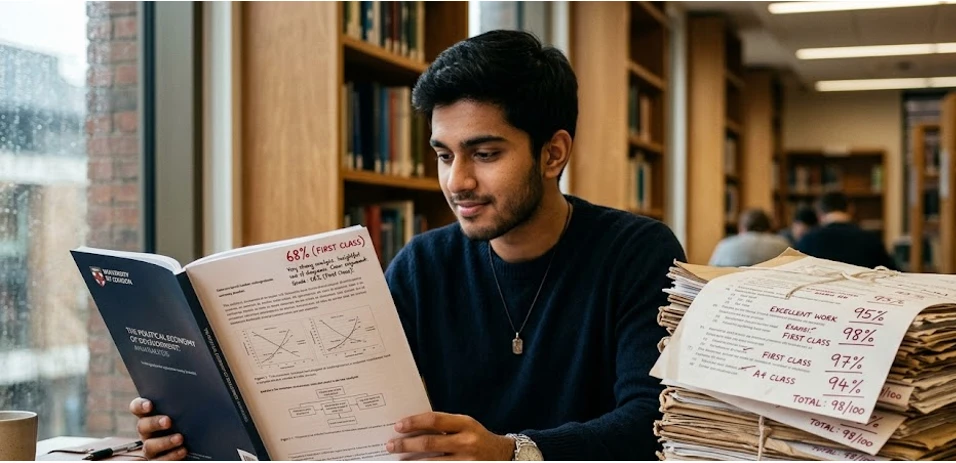
Another significant source of anxiety for Indian students pursuing University of London degrees is the grading system. In the Indian academic environment, scoring between 90% and 100% is a common benchmark of high achievement, particularly within CBSE, ISC, and state board structures. Students, parents, and university admissions officers in India are accustomed to viewing any score below 80% as a sign of academic mediocrity.
In the UK higher education system, however, the grading philosophy is fundamentally different. UK examiners utilize a grading scale where marks above 70% are deliberately reserved for truly exceptional, original, and publication-ready work. The scale is structured to prevent grade inflation and to reward critical brilliance.
Admissions Criteria and the Regulatory Landscape in India
Enrolling in international courses in India requires navigating specific academic requirements and understanding how foreign qualifications are treated within the Indian regulatory framework. The admission criteria for University of London undergraduate programs are designed to select students with strong academic potential and language proficiency, while providing flexible entry pathways.
1. Academic Eligibility Criteria
To gain direct admission to the standard three-year BSc programs, applicants must meet specific requirements across different educational boards.
| Educational Board | Minimum General Entry Requirement | Compulsory Prerequisites | Alternative Entry Pathways (CertHE / CHESS) |
| Indian National/State Boards (CBSE, CISCE, NIOS, State Boards) | Overall average of 70% or above in Year XII across 4 acceptable academic subjects. | Minimum 50% in Year XII Mathematics and English (Year X marks can be considered for math if not met). | Certificate of Higher Education in Social Sciences (CHESS) for students with scores below 70%. |
| UK GCE A-Levels
[cite: 38] |
Passes in 3 GCE A-Levels (Grade A-D) or 2 A-Levels plus 3 GCSE/O-Levels (Grade C/4 or above). | Mathematics, Psychology, or Biology at GCE A-Level (for BSc Psychology / BSc AI). | Performance-Based Admission (PBA) route by completing two required modules at 40% or above. |
| International Baccalaureate (IB)
[cite: 38] |
Successful completion of the IB Diploma with points 3 or above in standard or higher level subjects. | Mathematics must be passed at standard or higher level (Grade 3-7). | IB Certificate with equivalent of 6 O-Level passes including Mathematics and English. |
2. English Language Proficiency
All applicants must demonstrate competence in the English language. This requirement can be satisfied by scoring at least 50% in Year XII English from a recognized Indian board or by obtaining an acceptable grade in standard international tests.
| Proficiency Test | Minimum Acceptable Score | Sectional Thresholds / Minimum Subscores |
| IELTS (Academic)
[cite: 30] |
6.5 overall | No individual subscore less than 5.5. |
| TOEFL (iBT)
[cite: 30] |
90 overall | Reading: 18, Listening: 17, Speaking: 20, Writing: 17. |
| PTE Academic
[cite: 39] |
59 overall | Minimum of 59 in all subscores. |
3. Regulatory Framework and Domestic Recognition
The recognition of international degrees within India is a critical consideration for students planning to pursue public sector careers, sit for civil service examinations, or enroll in domestic postgraduate courses. Historically, the Association of Indian Universities (AIU) maintained strict regulations regarding foreign qualifications, often refusing equivalence certificates for degrees obtained through distance learning or local study centers.
The Local Support Ecosystem: Empowering the Learner
While the University of London curriculum is academically demanding, the key to student success is the structured academic ecosystem provided by recognized local teaching centers. Pursuing a UoL degree independently via distance learning often results in high dropout rates and academic frustration due to isolation and lack of structured guidance.
However, studying at a dedicated teaching center like Russell Square International College in Mumbai provides a structured, supportive pathway that helps students bridge the gap between Indian secondary school and the rigorous demands of the British higher education system.
This local support model provides several distinct advantages that help students succeed in a challenging academic environment:
1. Small Batch Sizes and Personalized Mentorship
In a standard Indian university, classes often accommodate 100 to 150 students, reducing lectures to one-way presentations. This setup leaves little room for individual questions, interactive debates, or targeted feedback.
Russell Square International College in Mumbai addresses this issue by maintaining small, focused class sizes. This low student-to-teacher ratio ensures that students are not lost in the crowd. Instead, they receive personalized mentorship and individual academic attention, helping them transition smoothly into the challenging curriculum.
2. A Dedicated Team of Expert Mentors
The faculty members at RSIC are not just instructors; they are qualified academic mentors approved and trained under University of London guidelines. With deep academic expertise—including a high percentage of PhD holders—these professors understand the common pitfalls Indian students face when adjusting to British evaluation standards.
Through structured tutorials, intensive workshops, dedicated doubt-solving sessions, and regular formative assessments, the faculty helps students unlearn rote patterns and develop strong critical thinking and analytical reasoning skills.
3. Creating a Top-Notch Educational Environment
Success in a rigorous international program requires more than just classroom lectures; it demands a comprehensive, resource-rich academic ecosystem. Located in the vibrant neighborhood of Juhu in Mumbai, RSIC provides a modern campus with state-of-the-art infrastructure designed to foster a dynamic and collaborative learning environment.
- Advanced Academic Resources: Classrooms are air-conditioned and fully equipped with modern teaching tools. The campus features dedicated IT-enabled computer labs, specialized science facilities, and a well-stocked library containing international journals, standard reference texts, and extensive digital resources. This ensures that students have direct access to the tools they need for high-level independent research.
- Dynamic Co-Curricular Activities: Academic growth is balanced by a wide range of extracurricular clubs and societies, including the Debate Society, the Finance Club, and the Psychology Forum. These platforms allow students to explore their intellectual interests outside the classroom, participate in case study competitions, and build leadership skills in a collaborative peer environment.
- Comprehensive Student Support Systems: The transition to a demanding global degree can be stressful. Recognizing these academic pressures, the college provides access to trained on-campus counselors and structured mental health support systems. This ensures that student well-being is prioritized alongside academic performance.
- Modern Recreational and Sports Facilities: To promote holistic physical and social development, the Juhu campus offers excellent recreational spaces, including a football turf, a basketball court, a gymnasium, a swimming pool, and indoor sports facilities for table tennis, carrom, and snooker. This creates a vibrant campus community that balances academic focus with recreational engagement.
Conclusion:
In final analysis, the University of London curriculum is not too difficult for the average Indian student, but it is fundamentally different. The perceived difficulty stems from the sudden shift from a highly structured, memory-based secondary school system to an analytical, research-intensive, and self-directed university model. This transition represents an initial academic hurdle, but it is completely surmountable when supported by a dedicated local teaching center.
Choosing an institution like Russell Square International College in Mumbai provides students with the best of both worlds. It offers the rigorous academic standards and global prestige of a world-class British degree while providing the structured mentorship, personalized support, and vibrant campus life that Indian high school graduates need to succeed. By encouraging independent inquiry, critical reasoning, and real-world application, this educational pathway does not just test a student’s academic capacity; it transforms how they think, analyze, and communicate. Ultimately, it prepares average Indian students to overcome academic challenges and become confident, resilient, and highly successful global leaders.