
Mumbai, as the commercial and financial capital of the nation, has emerged as the epicentre of this academic shift. This analytical report provides a comparative assessment of the three most prestigious premium undergraduate pathways available in the city: Russell Square International College (RSIC), Atlas SkillTech University, and the Anil Surendra Modi School of Commerce (ASMSOC) at SVKM’s NMIMS Deemed-to-be University.

To navigate this elite educational ecosystem, prospective scholars and global education strategists must evaluate these institutions across a multidimensional framework. Each institution represents a fundamentally different academic philosophy:
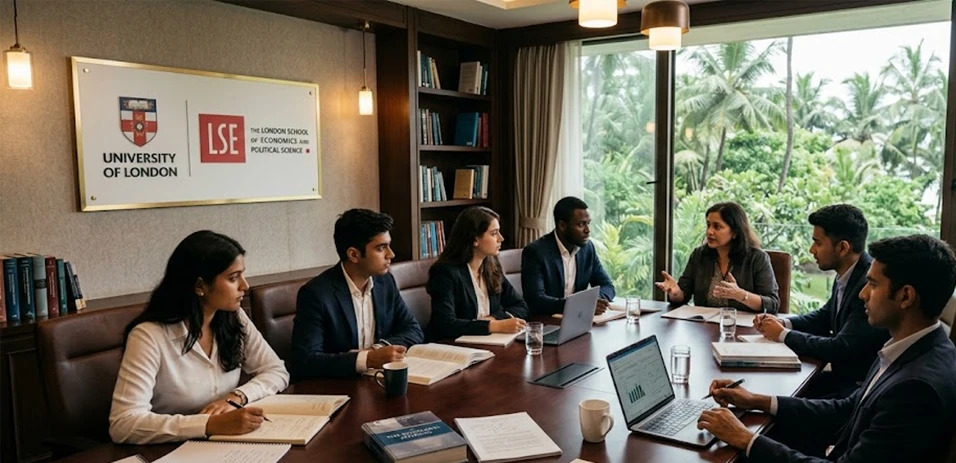
- Russell Square International College in Mumbai provides a direct pathway to classical British academic rigor, offering University of London (UoL) degrees under the direct academic guidance of world-leading institutions such as the London School of Economics and Political Science (LSE), Royal Holloway, and King’s College London. It delivers specialized international undergraduate education in Mumbai for students seeking elite global academic credentials and seamless pathways to top-tier international graduate programs.
- Atlas SkillTech University acts as an urban, multidisciplinary “SkillTech” hub that integrates design, technology, and management through a highly experiential, project-based curriculum aligned with the National Education Policy (NEP) 2020.
- NMIMS Anil Surendra Modi School of Commerce (ASMSOC) represents the highly competitive, structured, and quant-heavy domestic standard designed to produce corporate-ready managers for leading multinational firms and investment banks.
Institutional Profiling and Philosophical Foundations
The Architecture of Global Pedagogy at RSIC
Sustaining a highly selective, intellectually rigorous environment in the upscale residential district of Juhu, Russell Square International College in Mumbai represents a unique academic model within South Asia’s higher education sector. Established with the vision of offering high-level international courses in India, the institution operates as an officially recognized teaching centre of the University of London. This designation is not merely a collaborative partnership; it is a structural academic alignment.
The curriculum, syllabus, study guidelines, and final examination standards are developed directly by the elite member institutions of the University of London. LSE provides academic direction for programs in economics, finance, management, and accounting, ensuring that students in Mumbai are evaluated on the exact same intellectual scale as their peers studying physically in London.
The Disruption of Applied Experientialism at Atlas SkillTech University
Located in the Equinox Business Park adjacent to the Bandra-Kurla Complex (BKC), Atlas SkillTech University represents a modern shift in tertiary education. Established in 2021 under the Maharashtra Private Universities Act and recognized by the University Grants Commission (UGC), Atlas has designed its curriculum to meet the demands of the fourth industrial revolution. The university operates on a multidisciplinary, skill-centric model that deliberately blurs the lines between management, design, and computational technology.
Through specialized schools like the ISME School of Management & Entrepreneurship and the ATLAS uGDX School of Technology, the university prepares its students for the complex, tech-driven challenges of modern industry.

The Quantitative Corporate Mill of NMIMS ASMSOC
SVKM’s NMIMS Deemed-to-be University is a highly respected institution in the Indian business landscape, and its Anil Surendra Modi School of Commerce (ASMSOC) is widely considered one of the premier business schools for undergraduate studies in the country. Founded in 2010 and based in the active student district of Vile Parle West, ASMSOC is recognized for its rigorous academic curriculum, professional standards, and strong placement records.
The school’s primary goal is to produce highly skilled, corporate-ready analysts who can step directly into entry-level associate and analyst roles at global investment banks, strategy consultancies, and multinational corporations.
RSIC Entrance Criteria and Academic Systems Mapping
Admission to Russell Square International College in Mumbai is highly selective, evaluating candidates on their past academic performance and intellectual maturity through a rigorous interview process. The institution maps various academic systems to determine student eligibility:
Minimum Age Requirements
- Standard Degree Route: Candidate must be at least 17 years of age in the year of registration.
- Certificate of Higher Education in Social Sciences (CHESS): Candidate must be at least 18 years of age on or before December 31 in the year of registration.
System-Specific Entry Requirements
- Indian National Boards (CBSE / CISCE / NIOS):
- Candidates must pass Year XII with an average of 70% or above across four academic subjects, or achieve an overall average of 70% at Year XII.
- Candidates must pass Year XII Mathematics and English with a score of 50% or above. If Year XII Mathematics is not cleared at 50%, the candidate’s Year X Mathematics score may be evaluated under specific conditions.
- Indian State Boards (HSC):
- Candidates must achieve a score of 70% or above in each of their four primary academic subjects, or achieve an overall average of 70% at Year XII.
- If Year XII Mathematics is not cleared at 70% or above, the candidate must demonstrate a passing score of at least 50% in Year XII Mathematics.
- International Baccalaureate (IB) Diploma:
- Standard Degree Route: Candidate must successfully pass the full IB Diploma. Mathematics must be passed at grades 3–7 at either standard or higher level (excluding Mathematical Studies).
- CHESS Route: Candidate must hold an IB Certificate equivalent to 6 GCE ‘O’ Level passes with grades of 3 or above, including Mathematics and English.
- UK ‘A’ Levels / GCSE System:
- Standard Degree Route: Requires either two subjects passed at GCE ‘A’ level plus three further subjects passed at GCSE/GCE ‘O’ level with grades of C/4 or above; OR three subjects passed at GCE ‘A’ level plus one further subject passed at GCSE/GCE ‘O’ level with grade C/4 or above.
- CHESS Route: Requires at least one GCE ‘A’ level pass and four GCSE/O level passes, including Mathematics at grades A–C or 9–4; OR six separate GCSE/O level passes including Mathematics at grades A–C or 9–4.
Mandatory Application Documentation
To initiate the formal application process, candidates must submit the following verified documents to the RSIC Admissions Team:
- Three passport-sized photographs.
- Copies of Class X and Class XII marksheets.
- Copy of Birth Certificate or Passport (English translation required).
- Submission of the formal online/offline application form along with a registration fee of ₹10,000.
Atlas SkillTech Admission Mechanics
Atlas SkillTech University evaluates candidates through its own specialized entrance examinations and collaborative assessment models.
- BBA Entrance Pathway: Admissions are based on the Business Aptitude Test (BAT) and a structured personal interview. This is followed by a “Collaborative Accelerator” workshop where candidates are given a real-world design or business brief to solve in small teams, allowing admissions officers to evaluate leadership, communication, and collaborative skills.
- BTech Entrance Pathway: Requires a valid score in national or state-level engineering exams like JEE Main or MHT CET, or a high score on the ATLAS uGDX School of Technology entrance exam.
- BDes Entrance Pathway: Focuses heavily on the candidate’s portfolio review, creative design tests, and structured personal interviews to evaluate spatial and visual intelligence.
NMIMS NPAT Entrance Examination Structure
Admissions to the Anil Surendra Modi School of Commerce are based entirely on the NMIMS-NPAT, a highly competitive national-level computer-based entrance exam.
- Eligibility: Candidates must have cleared Year XII or equivalent from a recognized board with at least 50% aggregate marks. Mathematics or Statistics is a mandatory subject in Year XII for entry into the BBA, BBA (FinTech), and BSc Finance programs.
- NPAT Exam Format: A highly speed-oriented exam comprising three main sections: Quantitative & Numerical Ability, Reasoning & General Intelligence, and Proficiency in the English Language.
- Selection: The university generates a central merit list based solely on NPAT scores. Due to the high number of applicants, the cutoffs for the Mumbai campus are exceptionally competitive, requiring focused preparation.
Strategic Verdict: Aligning Student Profiles with Premium Pathways
Selecting the optimal premium undergraduate pathway is a highly strategic decision that must align a student’s quantitative aptitude, creative interests, financial resources, and career aspirations with the structural strengths of these elite institutions:

Russell Square International College (RSIC)
- The Strategic Value: Direct access to a globally recognized University of London degree under the academic direction of LSE, Royal Holloway, or King’s College London. This is an elite option for students seeking to build high-level quantitative skills and global academic credentials while remaining in a supportive, top-notch educational environment.
- The Global Advantage: Bypasses local credit-evaluation hurdles when applying to competitive postgraduate programs abroad. It offers seamless twinning pathways (such as the 2+1 model at Royal Holloway) and direct year-long study abroad options at LSE, providing students with invaluable global exposure and access to international professional networks.
- Ideal Archetype: High-achieving, intellectually curious students who want to study international courses in India and build careers in research, policy economics, global asset management, international development, or scientific psychology.
Atlas SkillTech University
- The Strategic Value: An urban, multidisciplinary university that integrates design, technology, and business through an experiential, project-based curriculum. This is a dynamic option for students who thrive in creative, collaborative, and non-linear environments.
- The Creative Advantage: Located adjacent to Mumbai’s primary business district, it offers direct access to a highly active ecosystem of startup incubators, design workshops, and technology laboratories. It is designed to develop practical, real-world skills that are highly relevant to modern digital and creative industries.
- Ideal Archetype: Aspiring entrepreneurs, product managers, digital branding strategists, UI/UX designers, and technology innovators who value continuous assessment and hands-on, applied learning.
NMIMS Anil Surendra Modi School of Commerce (ASMSOC)
- The Strategic Value: A highly competitive domestic standard that offers structured business programs with deep corporate integration. It is a premier pathway for students seeking immediate, high-yield placements at major domestic and multinational corporations.
- The Corporate Advantage: Leverages a massive institutional legacy and a powerful alumni network to secure structured recruitment opportunities at top management consultancies, global investment banks, and consumer brand leaders. It provides a reliable domestic return on investment (ROI) through a highly disciplined, quant-centric curriculum.
- Ideal Archetype: Highly structured, quantitatively focused students who thrive in demanding academic environments and want to secure high-intensity corporate analyst roles immediately upon graduation.